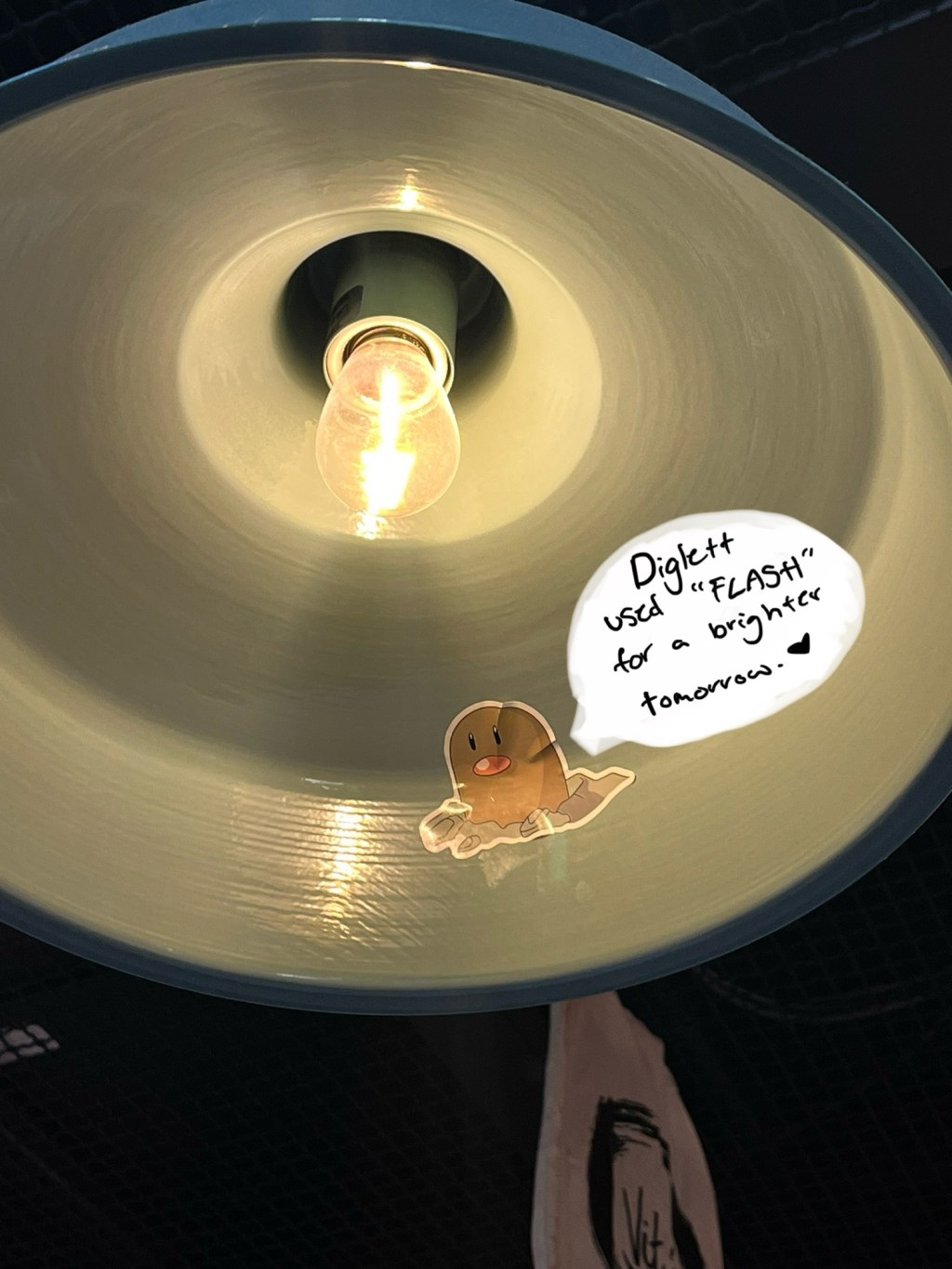
It’s silly. It’s bright. It might be exactly what we need to fight a global loneliness crisis.
By: Marie Pascual
A short personal pipeline
I was born in 1996, the year Space Jam dropped, the Spice Girls blew up, and Pokémon began its march to global takeover.
In early-2000s Scarborough, they called me “Mareep,” like the sheep Pokémon, because I always brought my cards to school even when teachers threatened to take them. My mom didn’t know my shows, but she recognized Pikachu. Once she asked if he was a happy mouse. Maybe that’s all we needed.
When COVID hit, my friends and I wandered quiet streets playing Pokémon GO. One friend’s mom, who couldn’t tell Pikachu from Digimon, got hooked and begged her daughter to drive her to spin Pokéstops. Someone else laughed that GO made him talk to more strangers in a month than he had in five years.
At my last cooking job, I brought in 100 Pokémon stickers just to kill time. My chef hid them everywhere, behind lowboys and inside stacks of containers, and later said it was the first time in months he didn’t dread a deep clean. Somehow it made work less lonely.
Loneliness is the real epidemic
Loneliness literally kills. The U.S. Surgeon General’s 2023 report found it raises the risk of early death by nearly a third, drives heart disease and stroke up by about 30 percent, and increases dementia risk by 50 percent. It is as dangerous as smoking fifteen cigarettes a day.
The World Health Organization has called it a pressing global health threat. In Canada, over half of older adults say they regularly feel lonely. And it’s not just seniors. One study found people under 30 now report the highest levels of loneliness ever recorded.
It doesn’t always show up in medical charts. Sometimes it’s just that small, dull ache: realizing your phone only lights up for Uber Eats, forgetting the last time you bumped into a friend by accident, or watching your Friday nights default to a couch and strangers laughing on your screen.
We’ve traded surprise visits for cautious DMs. Shared laughter for lazy emojis. We’re digitally tangled but drifting apart. It’s a quiet crisis, and one we rarely admit out loud.
Pokémon is a sneaky fix
Pokémon was never just about monsters. It has always been about tiny social sparks: card trades on playgrounds, Nintendo battles, community raids. Even now, it’s quietly pulling us back together.
For me, I had actually stopped playing Pokémon completely after 2017. My abusive ex had kind of ruined it, something bright and harmless twisted up with bad memories. I didn’t pick it up again until COVID, when I dug out my old 3DS and loaded Pokémon Alpha Sapphire. It felt like opening the door to a house that had always been waiting for me. Reliable, familiar, almost like coming home.
That small comfort isn’t unique. Psychologist Dr. Oren Amitay, a Toronto-based clinician, told Global News that Pokémon GO has a real upside: it gets people interacting, even if they start off awkward or shy. UBC’s Sean Seepersad wrote in Psychology Today that the game might actually help ease feelings of loneliness, something countless players say they’ve felt firsthand.
A market analyst from Newzoo put it simply: it’s one of the last billion-dollar IPs that consistently gets people off their couches and into shared spaces. That’s rare.
Nearly a decade in, Pokémon GO still draws about 55 million people monthly, with 20 million logging in weekly. In New York, GO Fest 2024 brought 68,000 players to Central Park and nearly half a million across the city. Just this June in Jersey City, another half a million players gathered from New York, New Jersey, and beyond.
Meanwhile, collector culture is somehow bigger than ever. The same kids who swapped holo Charizards are now adults, older and maybe lonelier, still chasing limited-edition sets, traveling for raids, or splurging on giant Pikachu plushes. In 2023 alone, Pokémon pulled in over $11.6 billion worldwide, more than Marvel or Star Wars.
In a world where most pop culture keeps us alone, binging Netflix, gaming in sweatpants, mindlessly scrolling, Pokémon might be one of the last truly massive global fandoms that still forces us into parks, sidewalks, and cafe patios.
“It’s been top of mind for a very long time,” says Michael Steranka, Pokémon GO’s Product Director, who promises their 10-year celebration will shock and awe and draw us back into shared spaces.
Why 2026 might be another Pokémon boom
Everything is lining up for a fresh obsession. The Pokémon Company is teasing new LEGO sets for the 30th anniversary. Rumors swirl that Generation 10 will drop on Nintendo’s long-awaited Switch 2. New TCG expansions keep fueling collector frenzies, kids and adults alike still hunting for a card that makes them feel twelve again.
The competitive scene is exploding too. The upcoming Pokémon World Championships are expected to smash attendance records, with thousands traveling just to watch strangers battle on big screens. Meanwhile, Niantic says the 10th anniversary of Pokémon GO will be their biggest push since 2016, aiming to revive that summer when parks overflowed and it felt like half the planet was chasing the same Pikachu.
It’s not just about nostalgia or bright merch. In a time when loneliness is officially a public health crisis, maybe we’re all primed for something that gets us off the couch and into each other’s lives again. Maybe we’re hungry for a reason to strike up conversations with total strangers, to shout across a park that we caught the same shiny.
Who knows? If the stars and Pokéstops align, 2026 could give us the closest thing we’ve had in a long time to a global block party.
If Pikachu can still spark joy at 30, maybe so can we
It’s bittersweet that we need a cartoon mouse to remind us how to show up for each other. But maybe that’s the point. It’s simple, low-stakes, a little goofy. You can’t doomscroll a Pokéstop. You have to step outside. You have to share a bench, call out “There’s a pokéstop over here!” maybe even laugh at yourself.
If Pokémon can still pull us out of our heads and back into each other’s lives, if Pikachu can still spark joy at 30, maybe so can we.
——————————————————————————————————————
References
Centers for Disease Control and Prevention. “Loneliness and Social Isolation Linked to Serious Health Conditions.” CDC, 29 Apr. 2021.
https://www.cdc.gov/aging/publications/features/lonely-older-adults.html
Office of the U.S. Surgeon General. Our Epidemic of Loneliness and Isolation: The U.S. Surgeon General’s Advisory on the Healing Effects of Social Connection and Community. May 2023.
https://www.hhs.gov/sites/default/files/surgeon-general-social-connection-advisory.pdf
World Health Organization. “Loneliness Is a Pressing Health Threat, Worsened by the COVID-19 Pandemic.” WHO, 3 Mar. 2023.
Newzoo. “Why Pokémon Remains a Billion-Dollar Global Powerhouse.” Newzoo Market Insights, 2024.
https://newzoo.com/insights/articles/why-pokemon-remains-a-billion-dollar-global-powerhouse
PocketGamer.biz. “Pokémon GO Continues to Thrive with 55 Million Monthly Active Users.” PocketGamer.biz, 2024.
Niantic Labs. “Pokémon GO Fest 2024: New York City Generates $126 Million in Economic Impact.” Niantic, Aug. 2024.
 Marie Pascual - Between Worlds
Leave a comment