This piece originally appeared on my Substack account.
ACT 1 — Toronto, 2016–2025
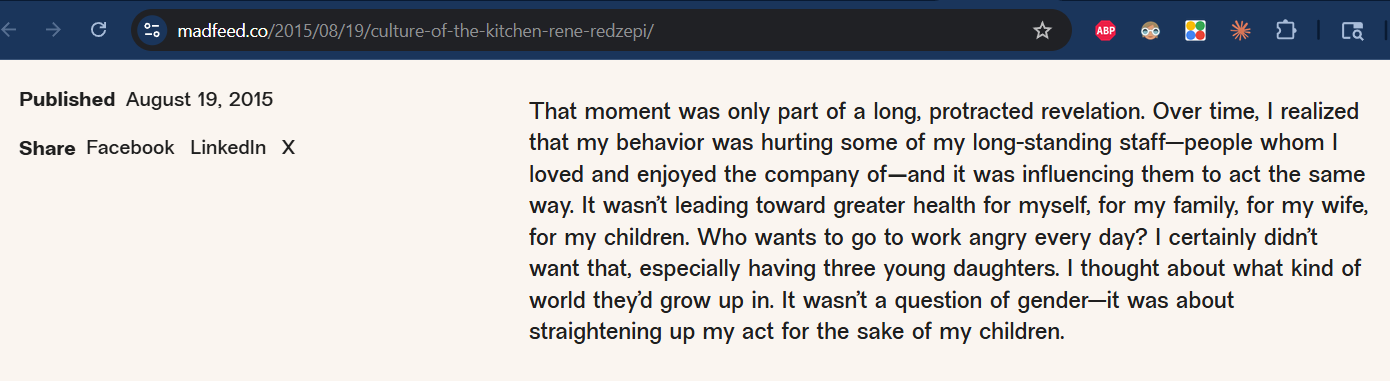
In 2015, René Redzepi wrote an essay called “Fantasies of a Happier Kitchen.” Sean, a Toronto chef I worked with, told me it inspired him to be a kinder leader when he got his first sous chef role. “Years later,” Sean said, “it sucks to learn that Redzepi may have been a BBQ fork-wielding sith lord all along.”
I spent the past decade in Toronto kitchens wanting to work at Noma anyway.
“Do you smoke?” asked Chef Danny at Lamesa.
I looked down at the cigarette, and back at the youngest Filipino fine dining chef in Toronto 2017.
“Yes.”
I lied.
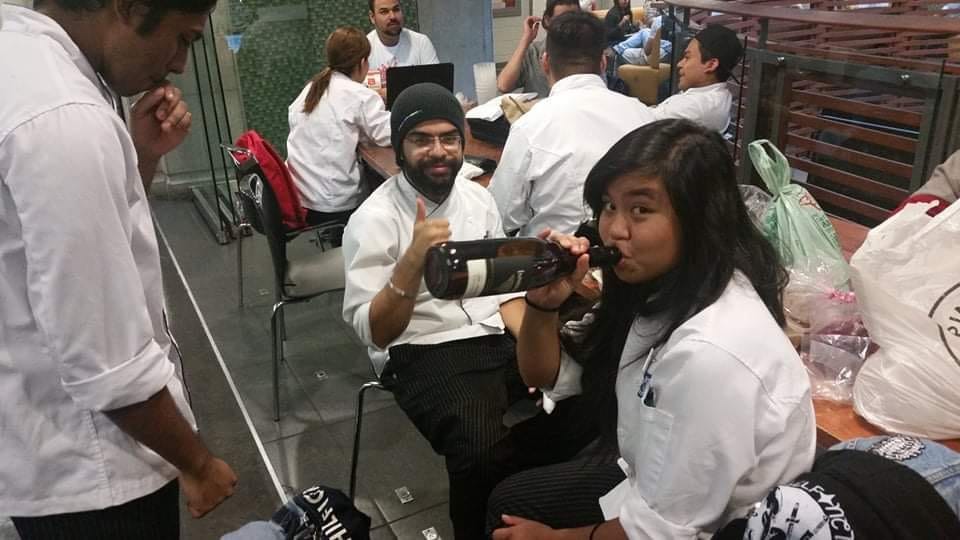
I started cooking in Toronto in 2016 at the age of 19. David Chang’s Lucky Peach was everywhere. Eddie Huang’s Fresh Off the Boat was popping off on Vice. Chef’s Table had just dropped on Netflix. Everyone in culinary school was talking about Thomas Keller, David Chang, René Redzepi — bragging about where they’d travel after graduation, who they’d stage under. I listened, and I wanted it too.
The kitchen ran on machismo: who worked 16 hours straight without breaks, who got stuck with a double, which “asshole” decided to take the day off. It was a dick-wagging contest.
Within my first semester of culinary school, I’d been raped by a classmate.
Within a week of my new job I was pressured into group sex by someone twice my age.
I inherited a severe nicotine addiction, wore my stove burns like a badge of honor, and drank to stop feeling bad about it all. Day wages were expected, and you always showed up to work if you had at least one hand in decent condition.
I was a small woman in a room full of men twice my size. I told myself this was the life Bourdain talked about. I pressured myself into things I didn’t want.
I stayed anyway.
Later I started looking for something different. At Vịt Béo, Dave opened the books to everyone on staff. “This is what we take in,” he said. “This is what we have to pay for. What’s left?” At first it felt like finally — someone willing to show us the numbers. Then it was just: okay, where do we cut? Which supplier has cheaper packaging? I spent hours going through the books trying to find twenty dollars we hadn’t thought of yet.
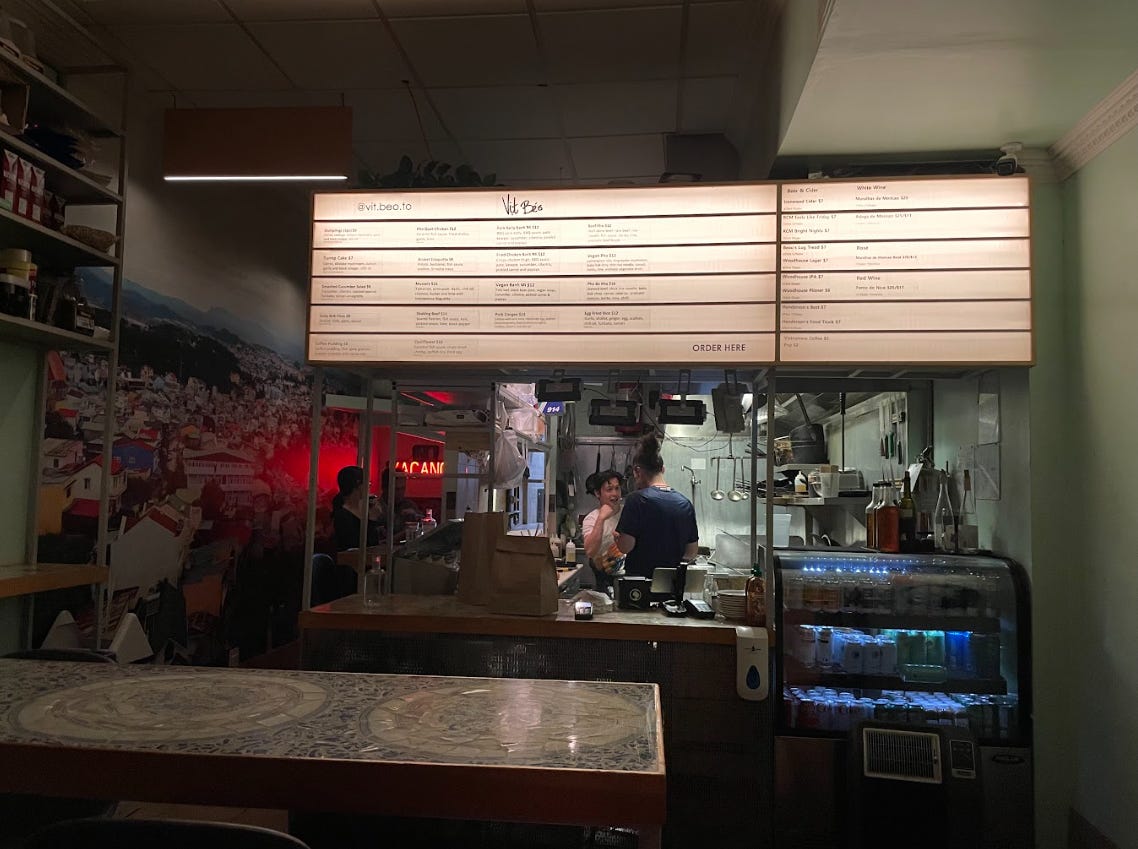
We never found enough.
Good kitchens existed. I’d worked in them. I knew what they felt like.
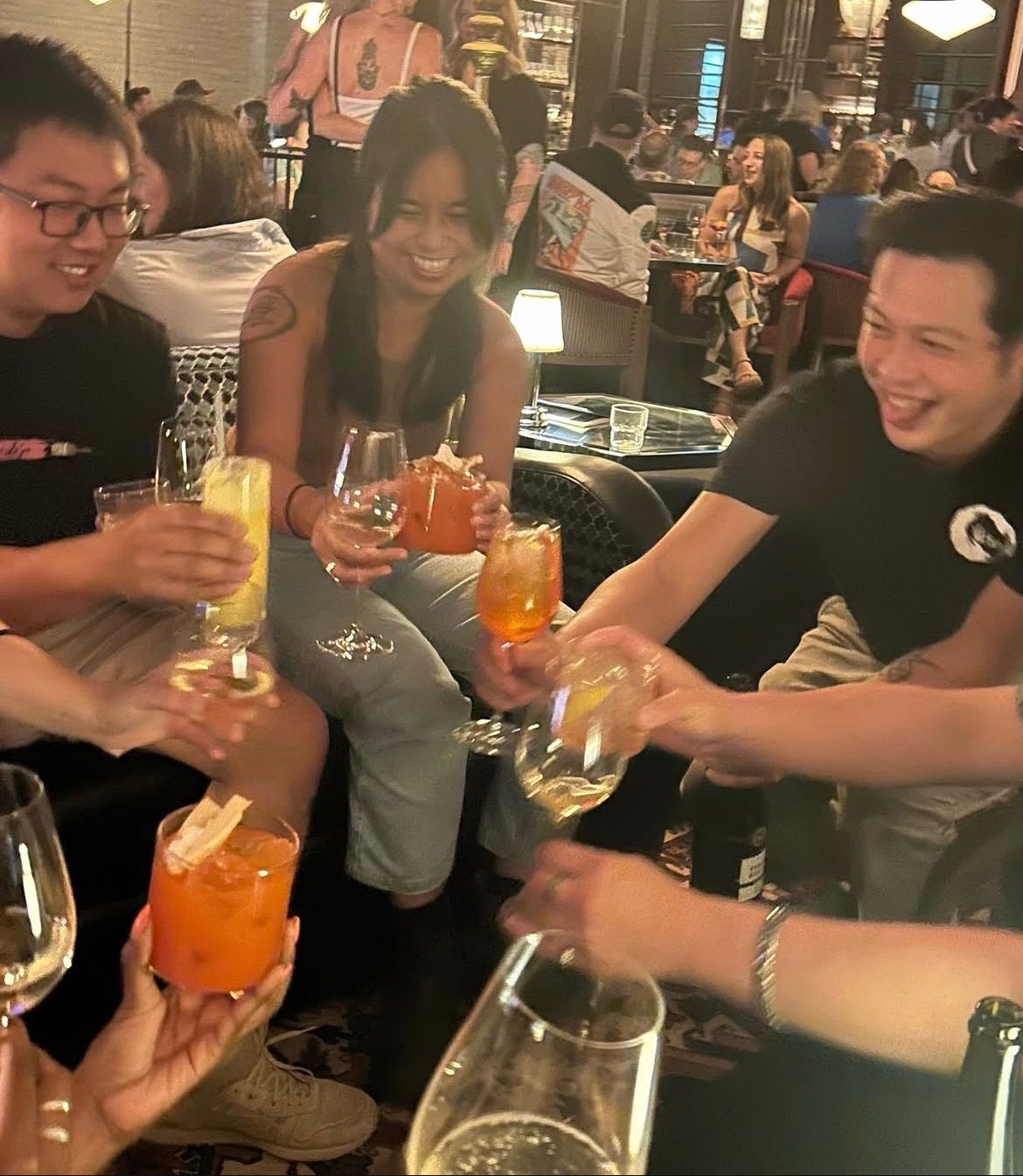
And I still wanted Noma.
Early in my career I had no business being anywhere near Lamesa, one of Toronto’s only Filipino joints doing upscale food at the time. I was a college dropout who slowed them down constantly and gave them more work than they needed. They let me stage anyway. When they started paying me I’d travel from Scarborough to pick up a cheque that took weeks to clear. That’s how I got to Lamesa, to DaiLo, to Patois. A passport to places I had no business being in, paid for in free labour. I just thought that’s how it was supposed to work.
Joe, a former cook who left the industry for construction, told me once: ‘Cool things only happen because rich people decide this doesn’t need to be profitable. Or people sacrifice their own time to make it happen.’ He still crosses his fingers that wherever the talent lands, at least they’re getting paid.
We all do. We throw everything we have at this even when it hurts because we learned early that suffering was the price of doing something that mattered.
In March 2026, Noma opened a $1,500-a-seat residency in Los Angeles while former employees protested outside. The tickets sold out in minutes. I booked a flight.
ACT 2 (A) — LA, March 10 2026
The thing about Noma is that in the industry it’s like saying Kobe Bryant. Everyone knows Kobe. My mom knows Kobe. Outside the industry, Noma sounds like something you get from drinking on an empty stomach. The people I was flying to cover don’t overlap much with the people who had $1,500 and the patience to book three years out. Because even I — someone who owns their books, who knows what they changed, who also couldn’t tell you why any of it matters to a line cook in Scarborough — was going to use their name to get my story told.
I flew to LA on my last $500. The same way young cooks put a Michelin name on their resume to get the next job. I just hadn’t admitted that to myself yet.
By the time I woke up on the second day, American Express, one of Noma’s sponsors, had already pulled their sponsorship. The company that had bought $100,000 worth of tickets to a $1,500 dinner was quietly backing out, donating the proceeds to worker organizations. Blackbird, another sponsor, followed. Their statement to the New York times was the most honest thing anyone in an official capacity had said about René in years — that his past practices were “unacceptable and abhorrent” and that they couldn’t “lean on time elapsed and rehabilitation claims when these things resurface.”
Time elapsed. Rehabilitation claims.
That’s what the 2015 essay was. That’s what every Noma-is-changing announcement was. A rehabilitation claim. And for eleven years the industry leaned on it. The sponsors leaned on it. I leaned on it.
The residency was still happening. Amex had bought six nights of the sixty-night residency. The other fifty-four were still running — roughly $63,000 a night, sixteen weeks total, about $3.4 million flowing through a restaurant whose former employees were protesting outside the gates.
That evening I went to a pre-protest gathering in Silver Lake.
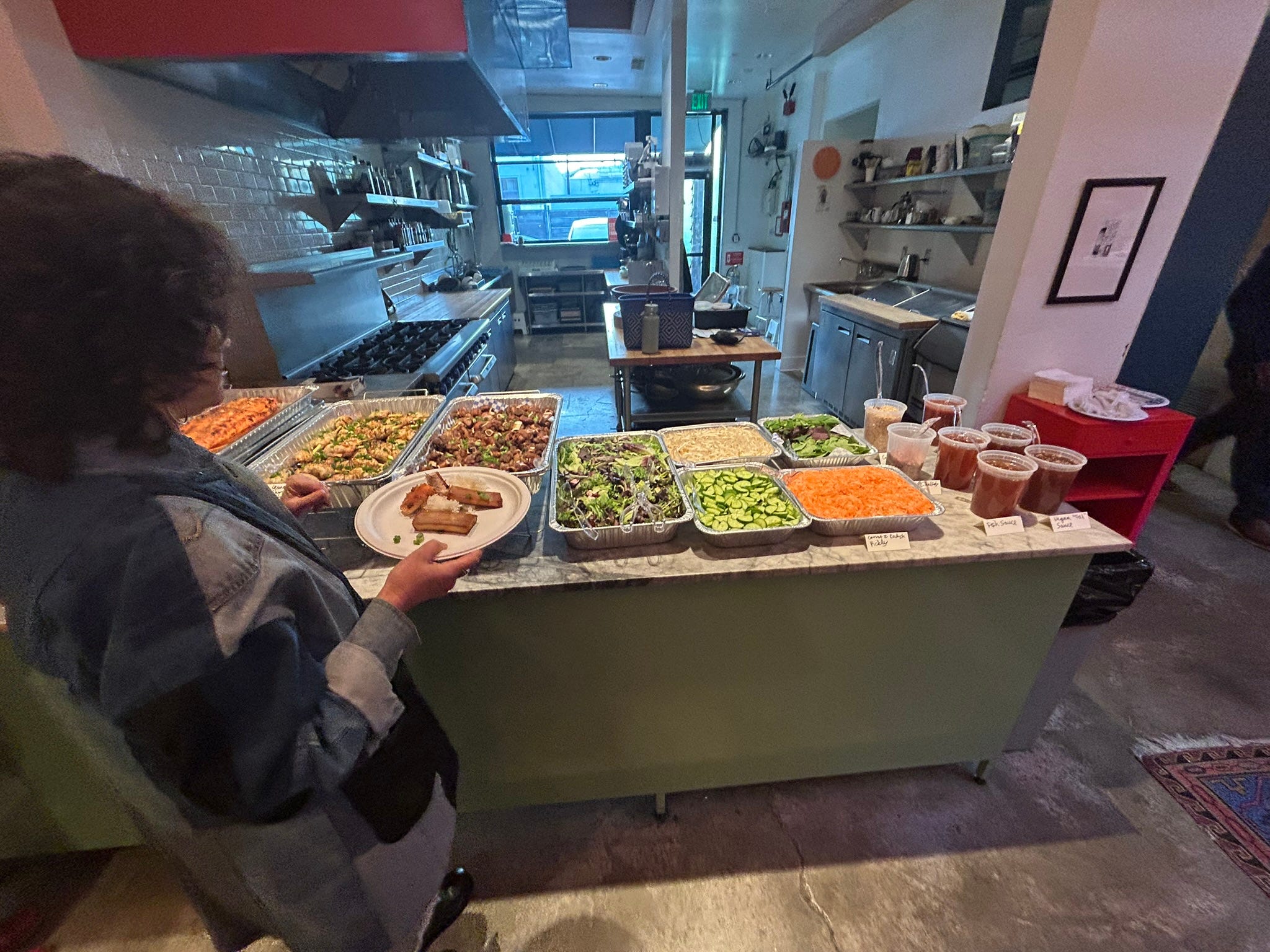
Jason Ignacio White — self-taught scientist, former Noma Fermentation Director, the man who’d organized this — turned away a reporter from the LA Times. He let the freelancers stay. He brought out Korean wines and caramels made from ten-year barrel-aged soy sauce and made sure everyone felt heard.
I stayed.
In that room I heard things I already knew in different shapes: the burn victim, the interns paying cash for rent in a city they’d moved their families to, the HR department that reported everything back to management. I’d heard versions of this in every kitchen I’d worked in. Nobody on the line is thinking about René Redzepi. But we’re all thinking about the people we love while being told he’s the gold standard.
Hannah Cupples, a cook who’d flown in from Colorado, put it simply: “A lot of people at this point consider Noma one of those places like the French Laundry — a pilgrimage site more than a restaurant.” She’d been a firsthand victim of physical and sexual violence in kitchens. She was here anyway. Everyone in that room was here because of what the name represented — the height the industry told us we should want to reach.
Nelson, my partner, pulled me aside on the drive back. He said: you didn’t fly here to report on Noma. You flew here to give Toronto cooks something they never get. He wasn’t wrong. I just hadn’t said it out loud.
Noma had switched service from dinner to lunch the day before the protest. Last-minute. To avoid the cameras.
ACT 2 (B) — LA, March 11 2026
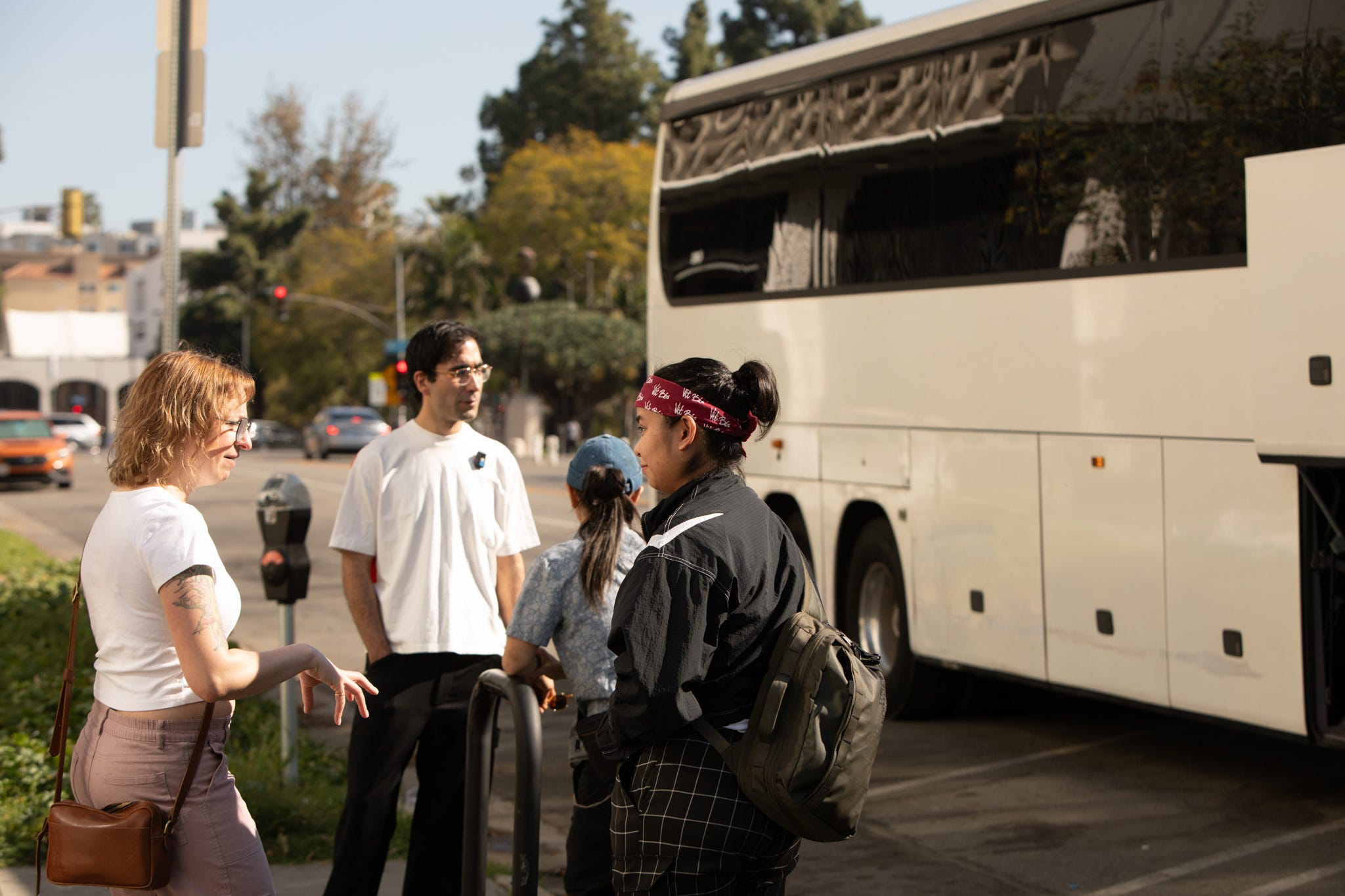
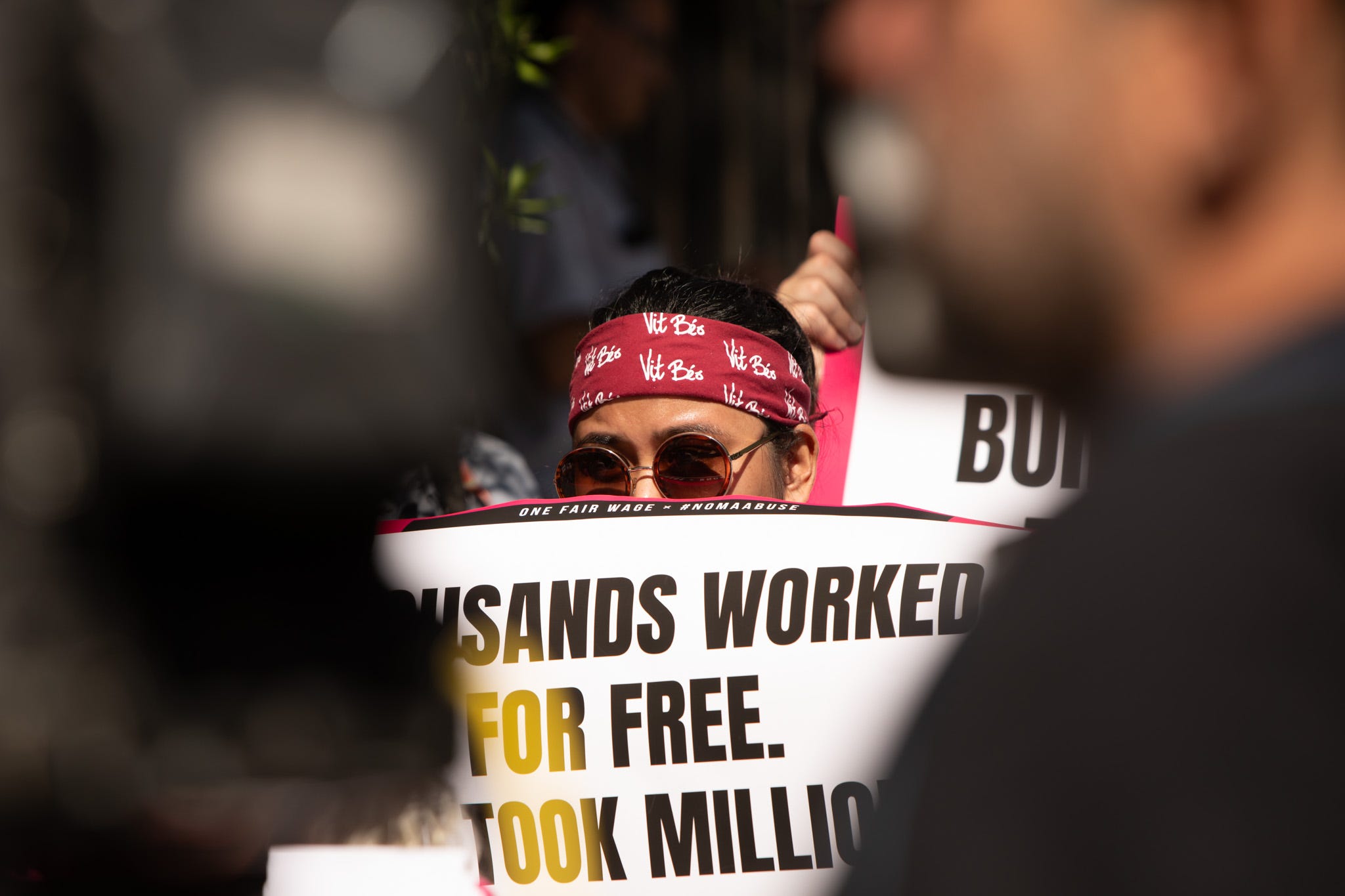
The next morning, by the time the shuttle dropped us off I knew this was actually happening. The press had beaten us there. Twice as many cameras as people, tripods set up on slopes because there was no sidewalk, vans parked along the sides of the road making the street even narrower. One of the OFW organizers was handing out more signs than there were people. Pots and pans. Chant sheets. A dozen and a half of us trying to balance four things with two hands. I lost track of where the documenting ended and the participating began.
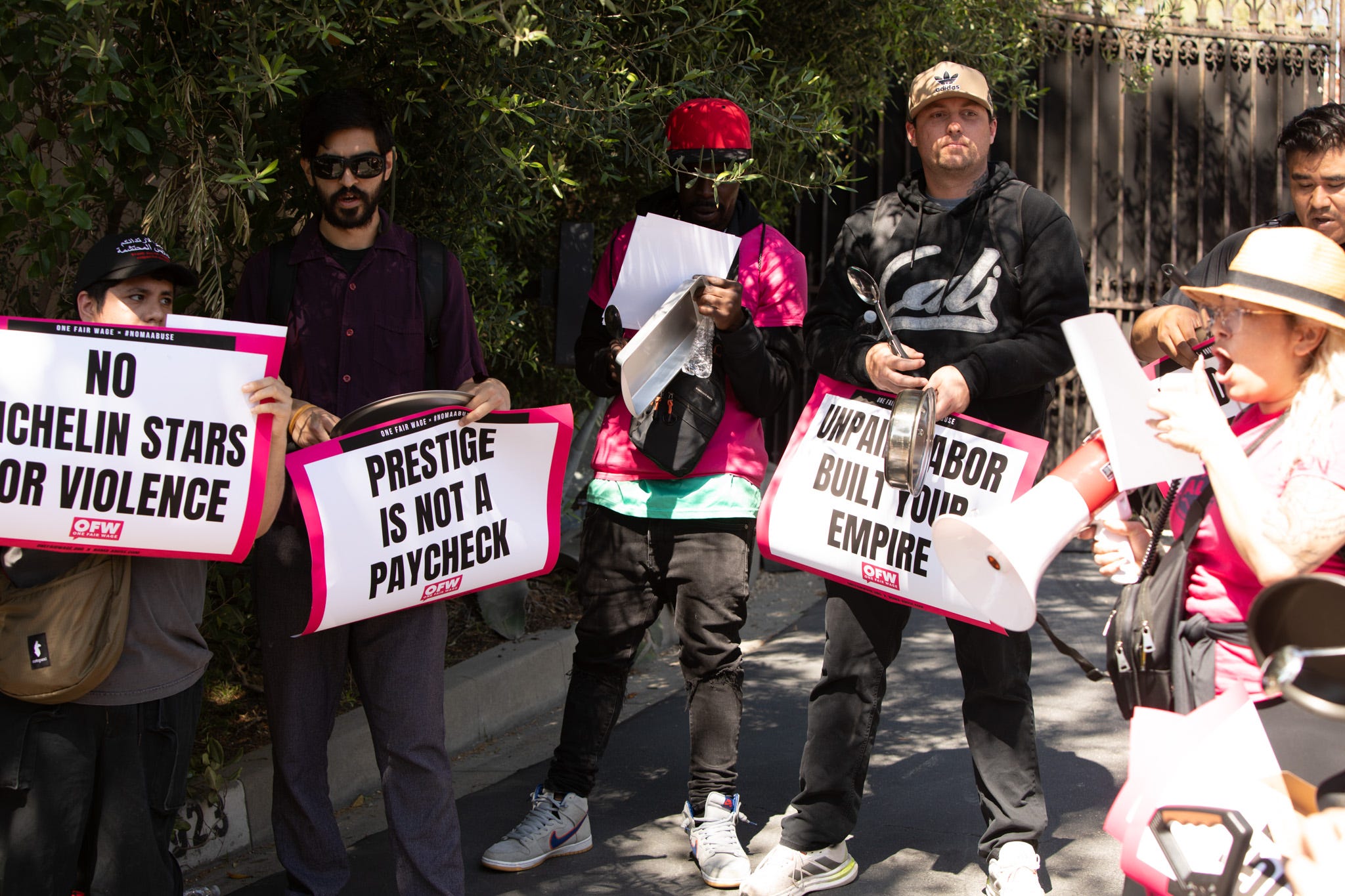
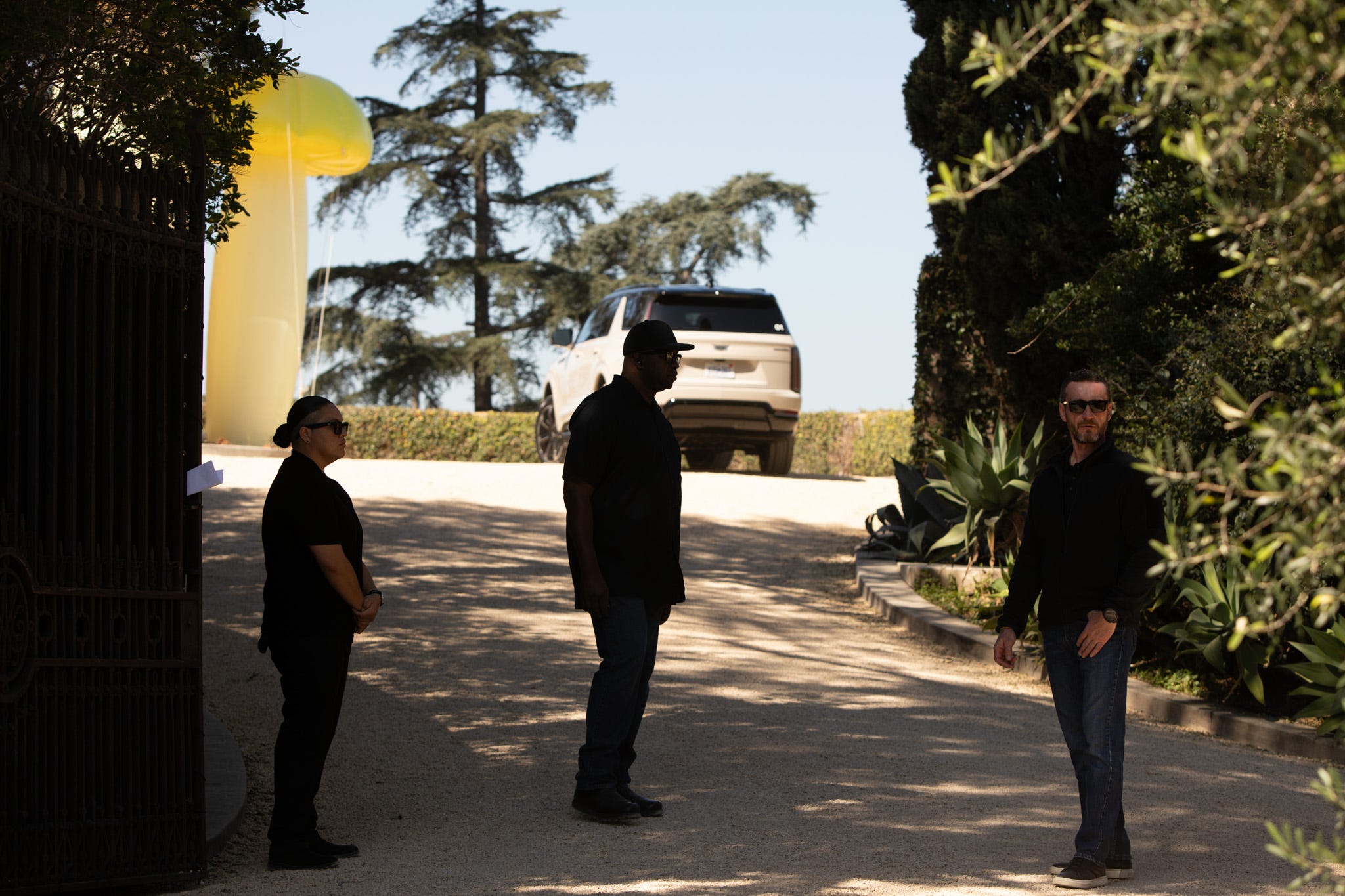
The first luxury car came up the hill. Passed the signs. Turned into the gate. Then another. Then another.


When the gates opened to let the guests through, there were giant inflatable mushrooms in the courtyard.
Dave had called it before I left: a colonizer’s attitude. “We don’t adapt to where we are. We make where we are adapt to us.” On that hill, watching the cars crawl toward the gate, I stopped thinking about Copenhagen and started thinking about the diners.
Kaz, a Toronto chef I’d worked under, had asked me the obvious question before I left: “Tell me you can’t figure out a way to make cheaper ingredients, fine dining, and still have your Noma flair, and make it affordable for people to actually eat?” He already knew the answer. “It was a choice. You’re just locking these people out because you don’t want them in there.”
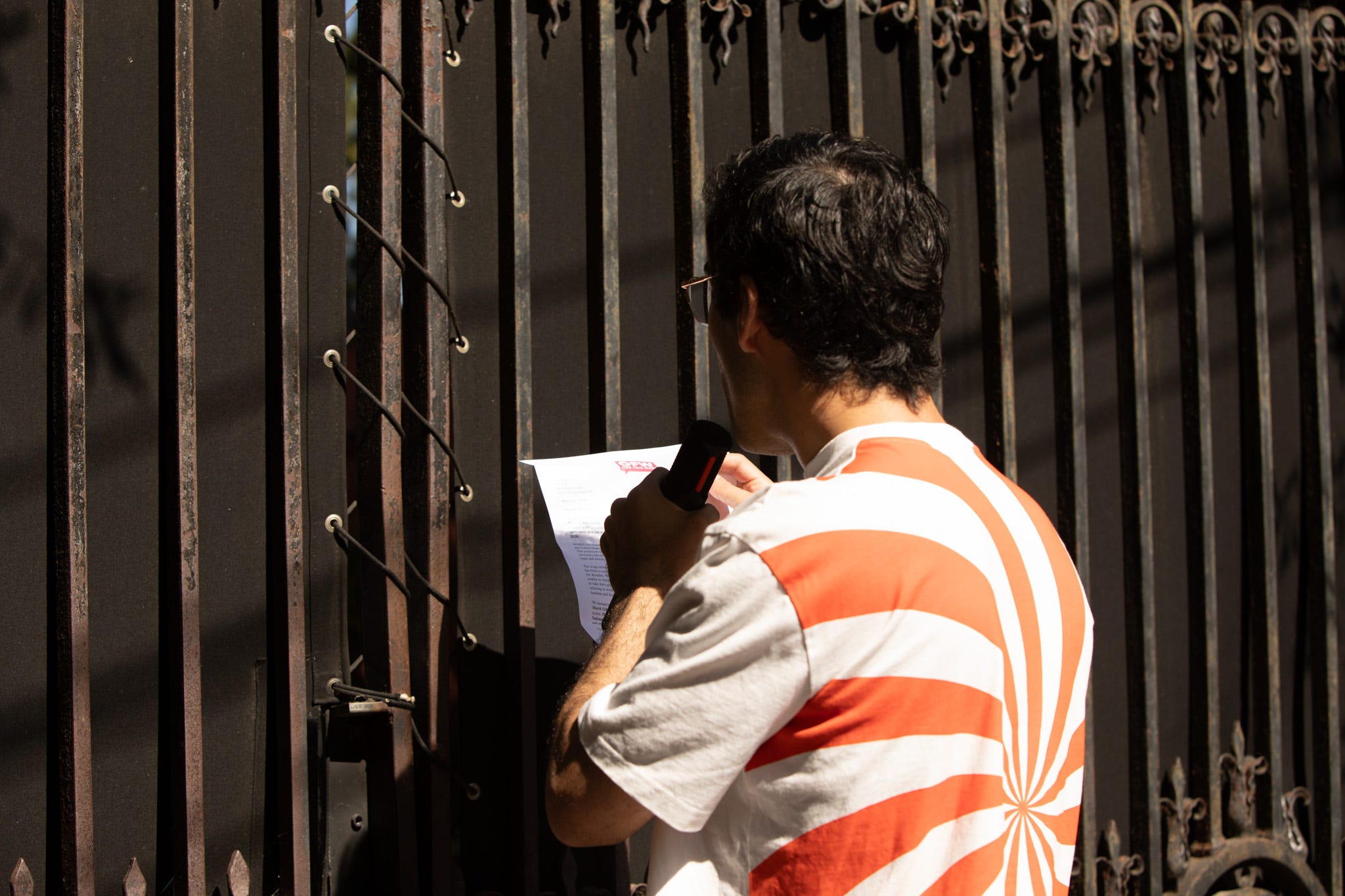
Jason walked to the gate and read the demand letter out loud to the press. Then he stepped forward and slid it through the bars.
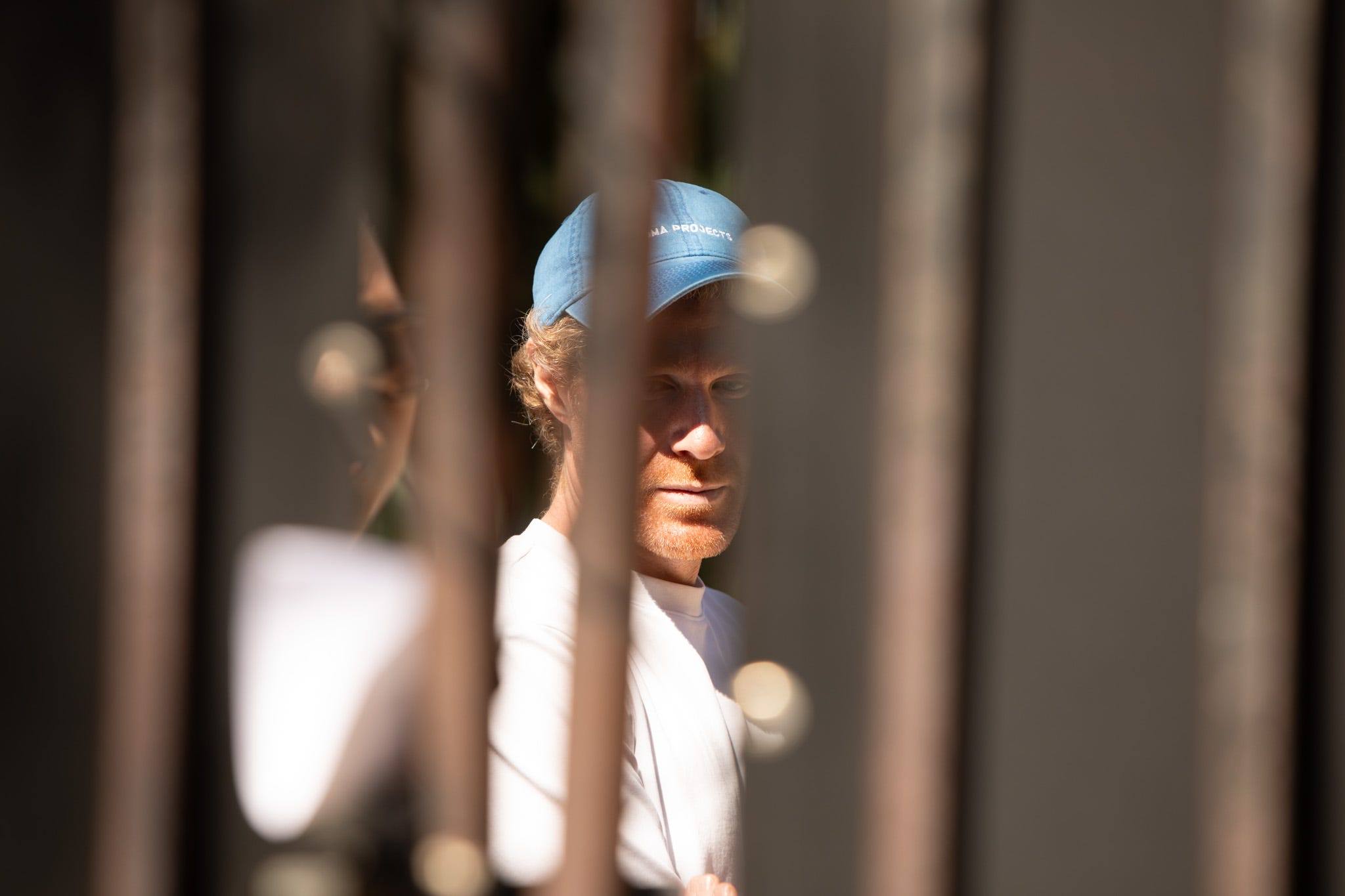
René wasn’t there. But his assistant was standing on the other side. Jason told us later, at Hannah’s place after it was all over: ‘At one point I was staring at him, he was staring at me, we locked eyes — then he just looked away.’
That was as close as it got.
I asked Jason, before the protest, why the industry keeps romanticizing these places even after the abuse is documented.
“It’s because fear,” he said. “No one’s ever really stood up to these people. So it’s like you don’t know what the result is of standing up — and then our peers basically don’t want to hear about it because either they’re suffering or they’re in their macho stage. They’re just like, ‘I can take it.’ But when you look back at it all it’s fucked up.”
He was specific about what the protest was asking for. Not just accountability in the abstract. René needed to “truly be held accountable for the suffering that he’s caused and then also be truly committed to no further harm or exploitation to the industry and the people around him.” An ask with conditions. A demand.
I ended up speaking at the press conference.
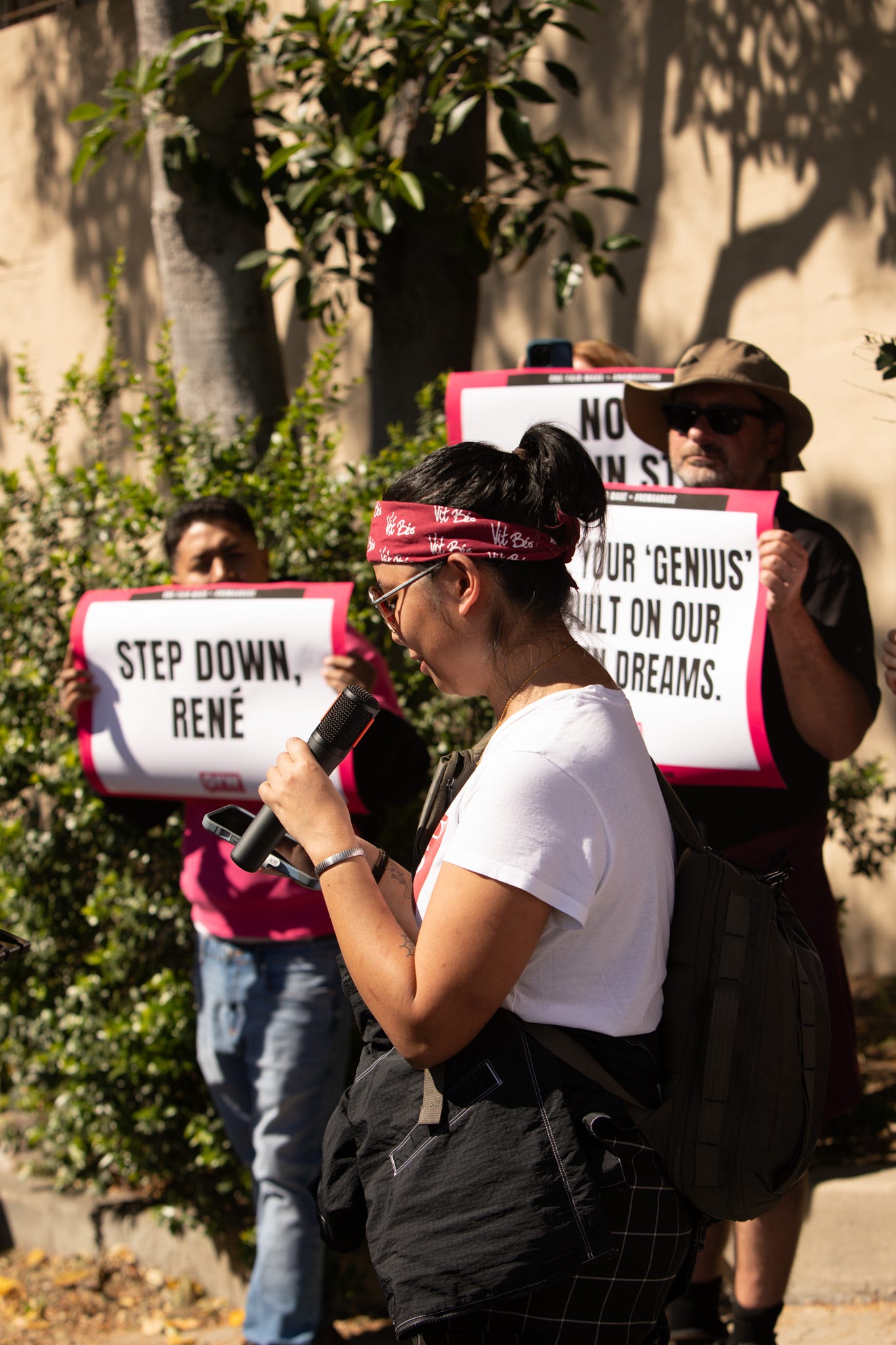
Jason hadn’t asked me. I volunteered. My hands and legs were shaking so hard I had to concentrate on keeping my voice steady. I talked about my mom — PSW, thirty years, ten dollars an hour to twenty-seven. I talked about the people I worked beside who never had a famous name attached to their suffering. At some point while Jason was speaking I realized I was watching the journalists in the crowd — clocking what they were writing down, how they were holding their recorders.
I had no idea which side of the line I was on anymore.
A few hours after the protest, René posted a video. Handheld camera. Soft and unfiltered in the way that only very produced things are. He said he was stepping down. He didn’t say Jason’s name. He didn’t address the allegations. He just said he was a man who had changed, and that the punishment didn’t fit who he was anymore.
By that evening the story wasn’t about the protest. It was about him.
The perfect LA Hollywood story needs a good guy and a bad guy, and when the bad guy finally admits defeat, the story’s over. Clean. Packaged. Ready to archive.
The dining room had been full at lunch.
ACT 3 — Toronto, the aftermath
I flew to LA to examine complicity. I came home having lived it.
I used Noma’s name to get a microphone. Jason used his Noma title to organize a protest. The sponsors used Noma’s brand to sell credit cards until it stopped being useful. The press showed up because it’s Noma. I showed up because it’s Noma.
Jason told me, before any of this started, that restaurants don’t teach you the things that would let you push back against them. “They don’t teach you like all this stuff. So we just endure it because you know like what the fuck else are you supposed to do.” He was talking about the industry. Standing on the other side of it now, writing about it, I realize he was also talking about me.
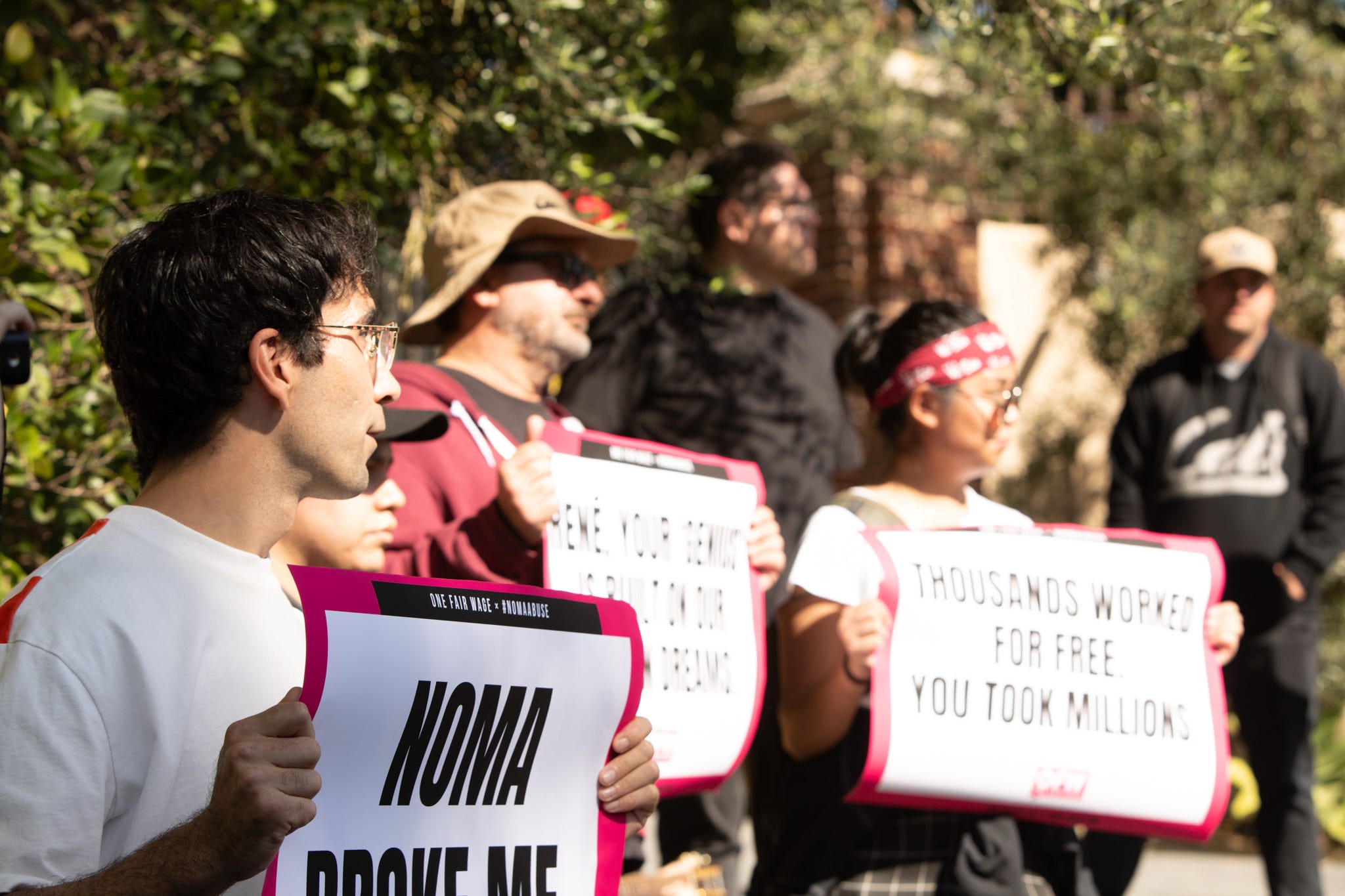
I didn’t stand outside the machine. I just found a more flattering angle to be inside it.
I came back with footage of a protest and a speech I gave in front of the cameras. I also came back with a selfie with Jason Ignacio White.
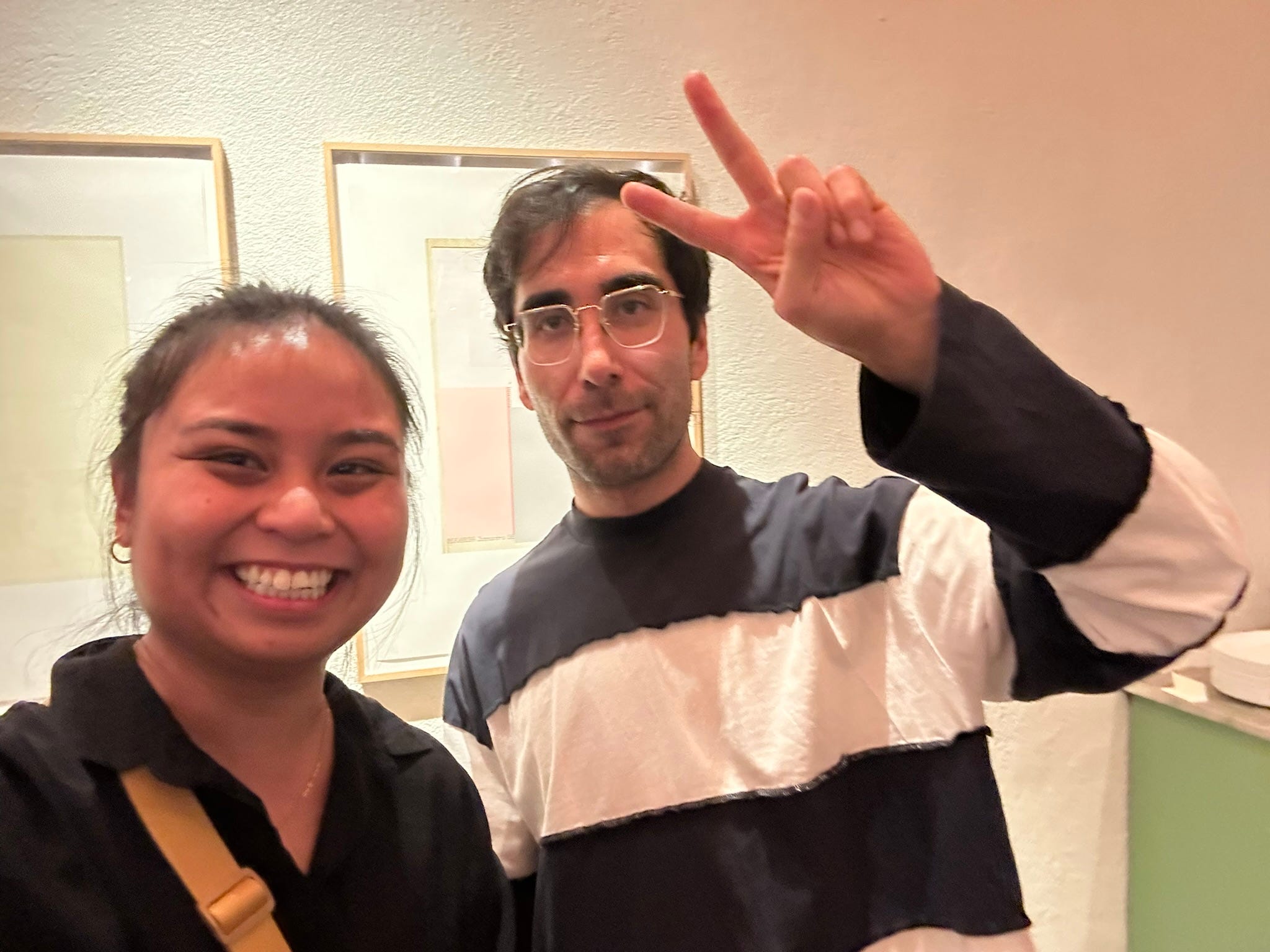
Back in Toronto, nothing had visibly changed.
René stepped down. He said he was still going to be around. The coverage was entirely about his departure — his framing, his words, his arc. The New York Times was the only outlet that published any part of Chef Uyen’s speech at the press conference. By the end of the week, people were debating whether this was enough. Whether it meant anything. The people who’d stood on that hill weren’t part of that conversation.
Sean put it plainly: “There’s shared blame for this problem. Consumers continue to support abusive restaurants with their money. Eager cooks continue to support them with their time. This puts the hospitality industry into a state of cognitive dissonance.” He was right. I am in that sentence. I am the consumer and the cook. Joe crossed his fingers. The diners did too. Same hope, different relationship to the machine.
The real story was always in Toronto. Vịt Béo, my mom putting on a strong face for seventy years on ten dollars an hour. Those stories don’t have a Noma attached to them. No cameras showed up. No one organized outside their doors. Just people getting ground up quietly, the way they always have, the way they always will unless someone decides their story matters without a famous name to make it matter first.
Duff’s famous wings closed. The Imperial Pub, gone. Jumbo Empanadas. Beef Noodle House.

Not abuse cases — victims of the same economics. Unsustainable margins, rent inflation, the math that never works out. We didn’t write think pieces about them. Nobody organized outside their doors.
Dave told me later that the transparency at Vịt Béo didn’t empower anyone. It just made the cage more visible. “This thing is broken,” he said. “This thing can’t be fixed.” He said that before LA. I heard it differently when I got back.
I still don’t know if any of it was enough. Or if enough was ever the point.
Maybe I just needed to go. To see it with my own eyes. To stand outside the gate and feel the pull of what was happening inside. To realize that the pull never went away — I just learned to do something different with it.
I stopped cooking there. I started writing about it instead.
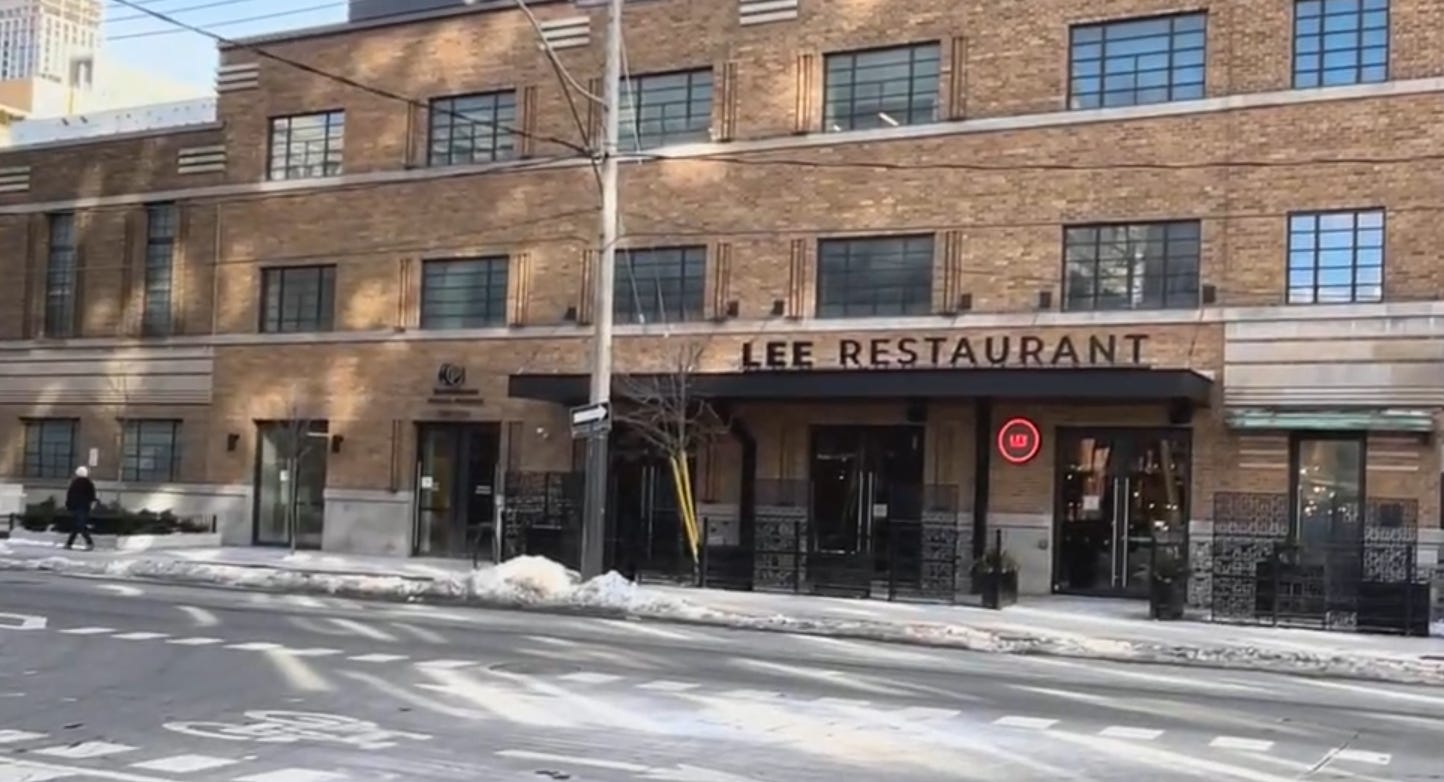
Susur Lee’s restaurant is still open. The IOU allegations are documented. The debate about whether to support it, whether proximity to abuse is the same as endorsement, whether awareness changes anything — that debate is still live. Nelson and I still have it. About wherever we go next.
Most days I still don’t know the answer. But I know what we’re actually debating now. Not whether the food is good.
Whether we’re the kind of people who choose aspiration over accountability.
Inside the machine with a different tool.
— END —
 Marie Pascual - Between Worlds
Leave a comment