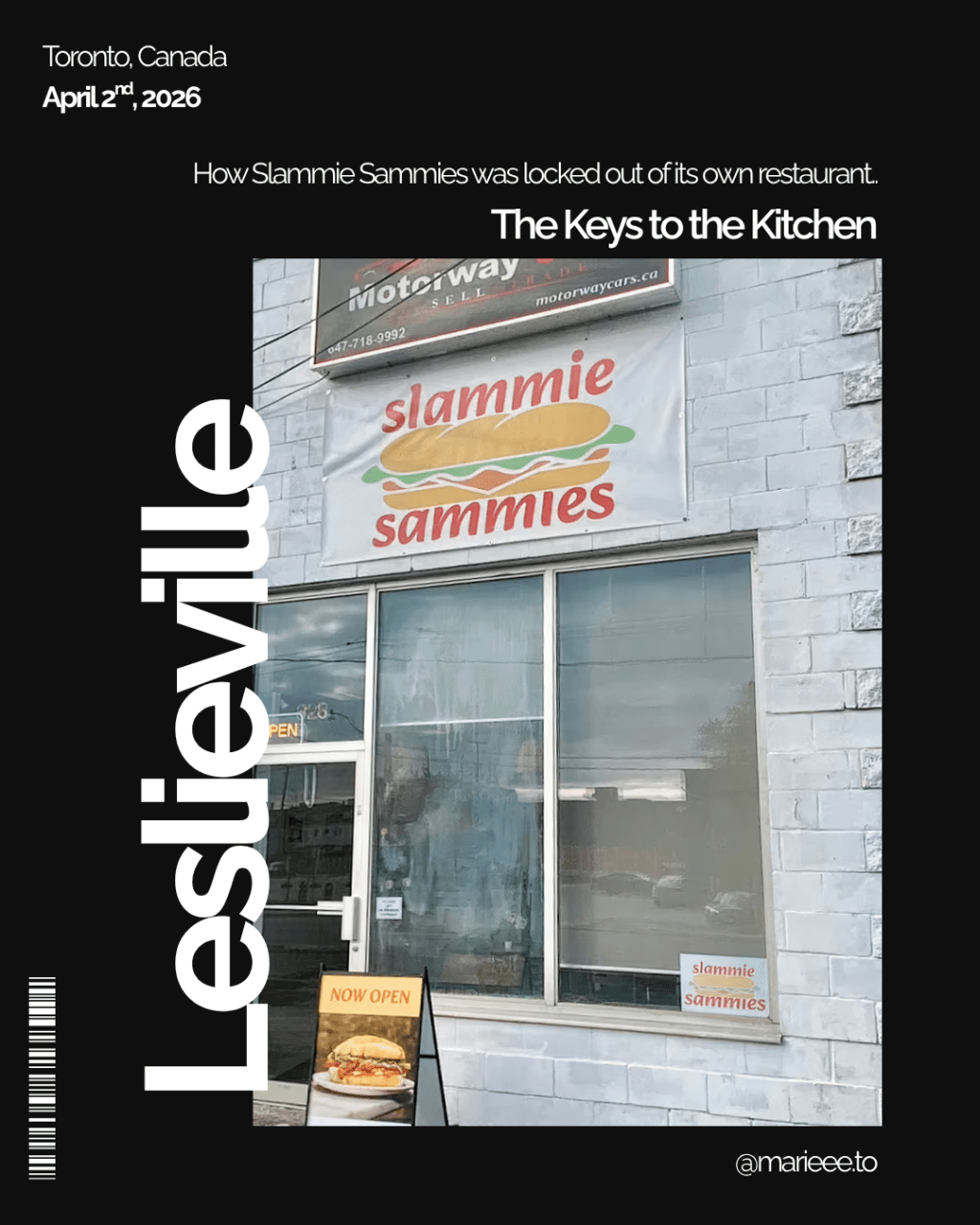
How Slammie Sammies was locked out of its own restaurant. Originally Published April 2, 2026 on my substack.
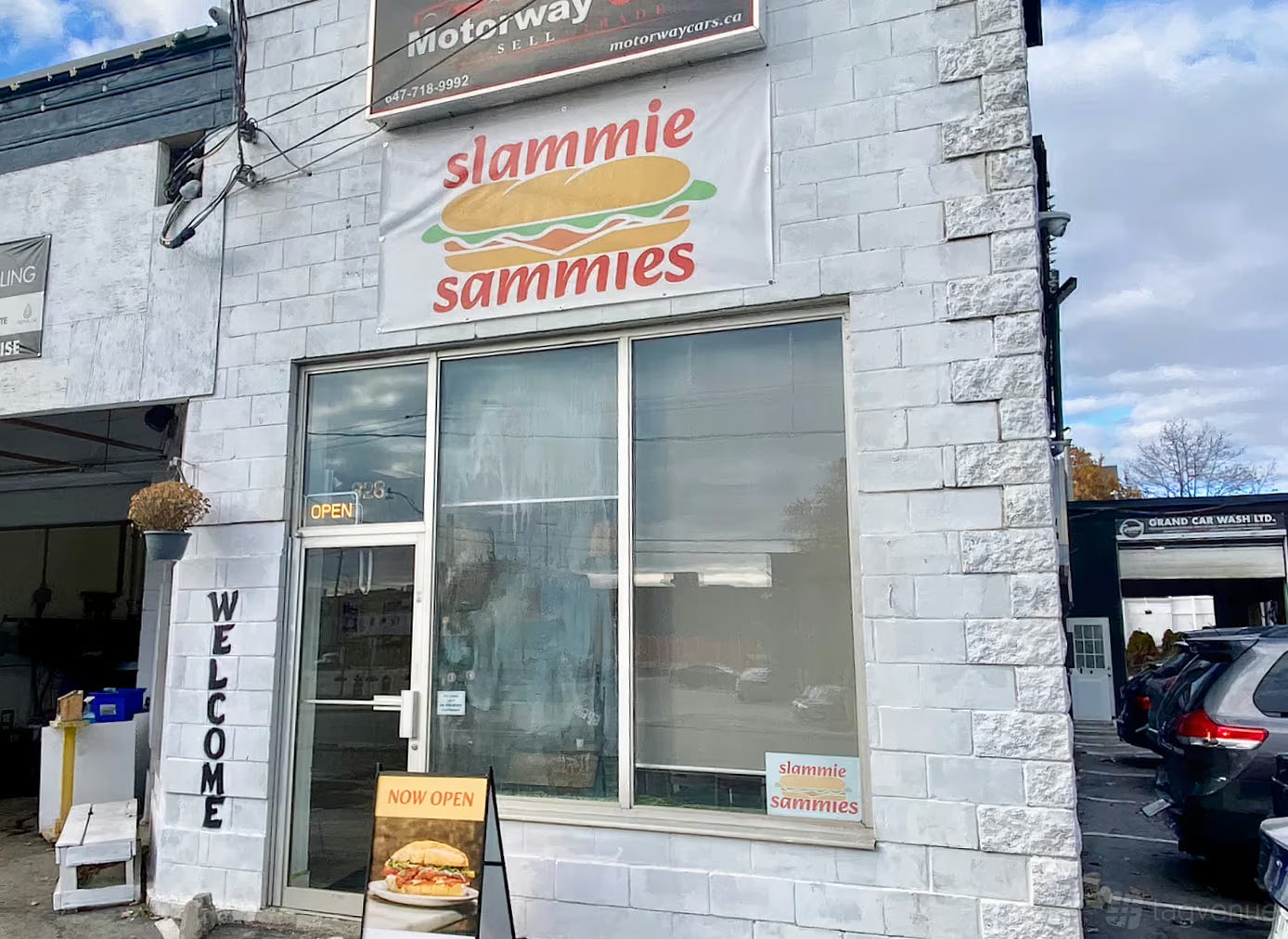
THE MORNING OF MARCH 6
On the morning of March 6, Pedro Dos Santos drove to 828 Eastern Avenue the way he had every working day since Slammie Sammies opened, with somewhere to be and something to make. When he arrived, the locks had been changed. His chef’s knives were still inside.
He had received no notice. No phone call. No letter.
Dos Santos has spent thirty years in professional kitchens. He is the kind of chef who, when the space at 828 Eastern needed a commercial suppression hood and the budget couldn’t absorb it, paid $20,000 out of his own pocket to put one in. His business partner, Marilyn Simms, brings twenty-two years of industry experience and runs Vert Casse-Croûte, a catering company she built before Slammie Sammies existed. Together, they built a sandwich shop concept rooted in the neighbourhoods they knew, named after the workers who kept the city moving: the TTC operators and postal carriers and city employees who became regulars, who Pedro knew by name, who made stopping in on a Friday something close to a ritual.
The shop earned a BlogTO feature. It earned a following. And on the morning of March 6, it went dark without warning. The kitchen was cold. The knives were locked inside. The sign was still up.
What happened between the founding of Slammie Sammies and that morning is a dispute with competing accounts and documentary records on both sides. But the locked door was not in dispute. Neither were the knives.
HOW THE PARTNERSHIP WAS BUILT (AND HOW IT WAS WIRED)
The partnership that would become Slammie Sammies began, as many things in the independent restaurant world do, with a search. Pedro and Marilyn were looking for an investor. Jay (Jermaine) Williams was looking for an opportunity. They found each other through a Kijiji ad.
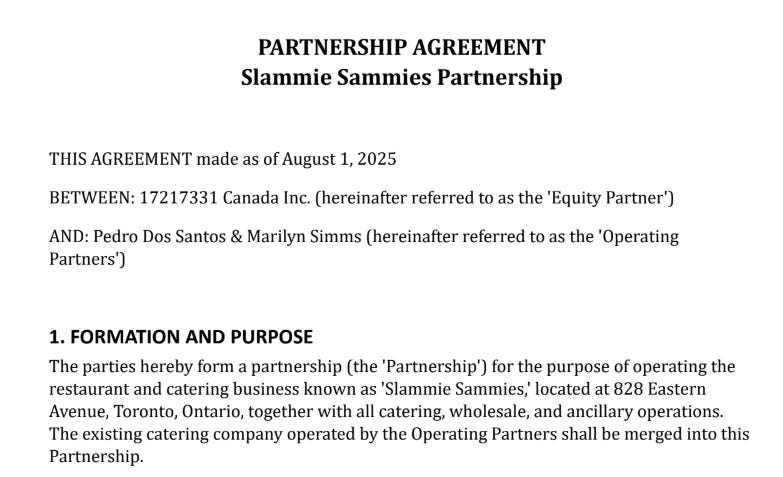
What they built together, on paper, was a 50/50 arrangement. Williams’ holding company, 17217331 Canada Inc., would serve as the equity partner, covering startup costs. Dos Santos and Simms would run the kitchen and the business. The partnership agreement dated August 1, 2025 stipulated that startup costs were “50% recoverable from the business once financially able to repay, on a timeline agreed upon by the Partners.” It was the kind of structure that depends, more than most, on trust. The landlord of 828 Eastern Avenue and the equity partner writing the cheques were the same person.
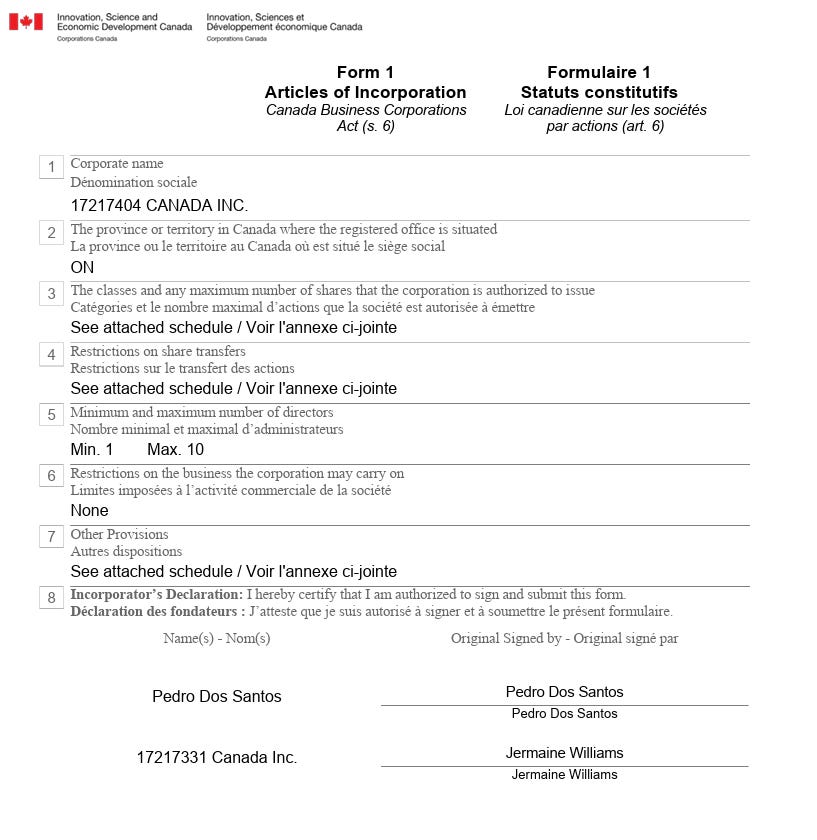
Before Slammie Sammies served its first sandwich, a document was filed that would not surface until the dispute.
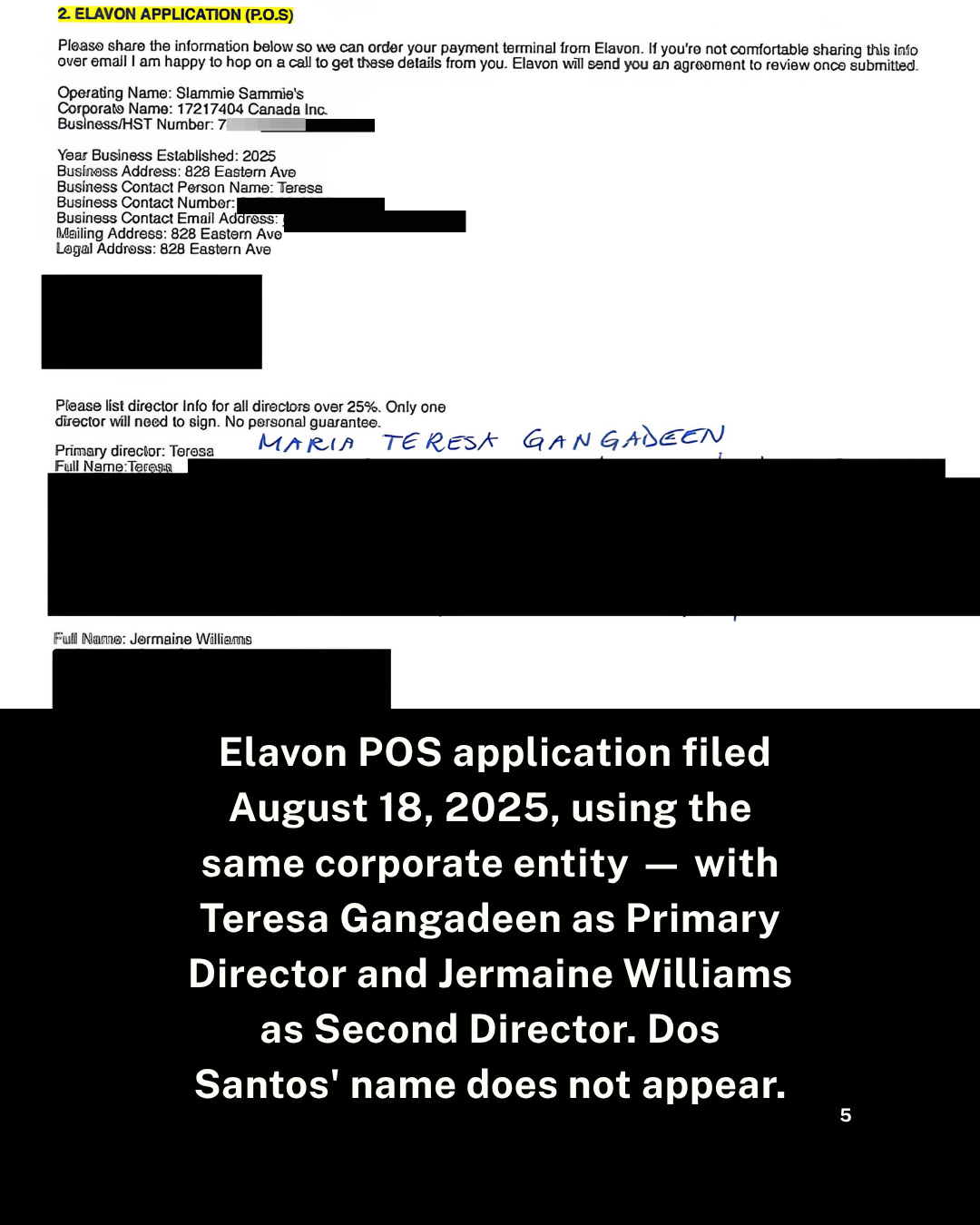
On August 18, 2025, an application was submitted to Elavon, the payment processing company that would handle every debit and credit transaction at the restaurant, listing the directors of 17217404 Canada Inc., the corporate entity through which the restaurant operated. The application named Teresa Gangadeen, Williams’ partner, as Primary Director. It named Williams himself as Second Director.
According to 17217404 Canada Inc.’s articles of incorporation, Pedro Dos Santos is the sole director.
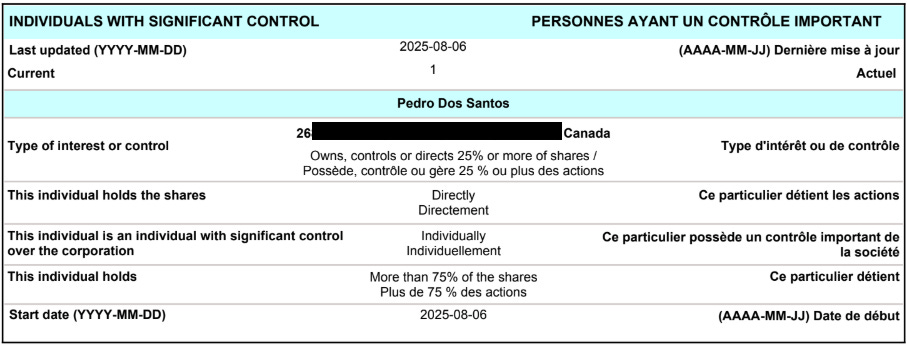
Neither Gangadeen nor Williams held that title legally. But on the Elavon application, the document that determined who controlled the payment terminal and who had authority over the financial infrastructure of the business, they were listed as if they did.
The restaurant’s debit machine processed every transaction Slammie Sammies ever ran. The application that established who controlled it named two people who, according to the corporate registry, had no legal directorship in the company at all.
Williams did not respond to questions about the Elavon filing.
THE MONEY (BOTH SIDES OF THE LEDGER)
The financial dispute between the two sides is substantial, and both have documentary records they say support their account.
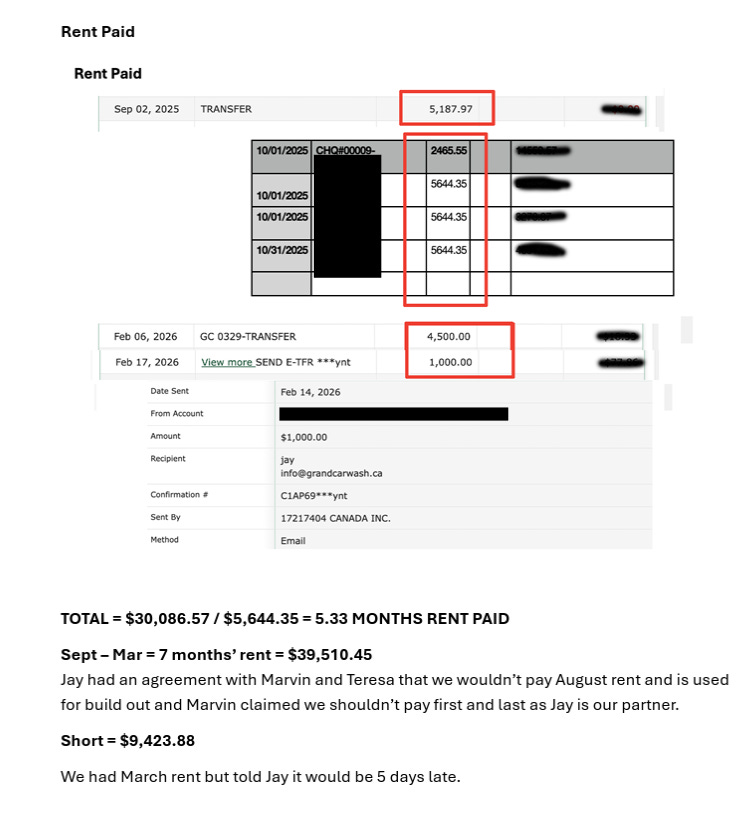
Pedro and Marilyn’s version begins with the rent ledger. Across seven payments from September 2025 to February 2026, they document $30,086.57 in transfers to Williams, with an acknowledged shortfall of approximately $9,423.88 over the tenancy. August rent, the ledger notes, was waived by agreement with Williams during the build-out period. March rent, they say, was ready but would be five days late, and Williams had been informed.
On the vehicle costs: Instagram DM records show that Williams declined a $4,000 transmission repair on the Subaru used for deliveries. The founders say that decision forced them into rental vehicles at approximately $1,600 a month, more than $11,000 over the course of the dispute, costs they say drained the business of operating cash.
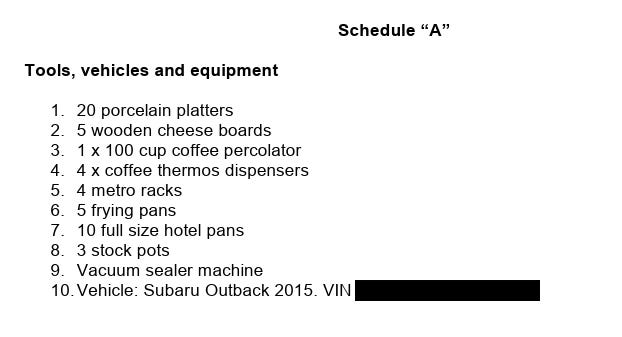
The vehicle itself was not a casual business expense. An Asset Purchase Agreement executed on October 23, 2025 (four months before the lockout) lists a 2015 Subaru Outback by VIN as a formal asset of Simms’ catering company, Vert Casse-Croûte Ontario Inc., transferred to Dos Santos’ company as part of a documented business transaction. The vehicle Williams described as a personal expense had a paper trail predating the lockout.
Williams tells a different story, and he tells it at length.
In a written statement provided in response to this article, Williams says the partnership began with a $75,000 investment, money he says covered not just startup costs but equipment, renovations, and a $4,000 monthly salary paid directly to the founders. “All they had to do was show up and cook,” he wrote. By September 2025, he says, a company credit card extended to the founders had reached a $50,000 balance, charges he describes as including cash advances, staffing agencies he says he never approved, and personal expenses including what he characterized as a personal car and utility bills.
He alleges that Simms used the card to cover expenses for a catering event for which she had already received a deposit that was not disclosed to him as a partner. “It was later realized,” he wrote, “that the only reason she was seeking investment in the first place, was to fund her expenses on this wedding job.”
Williams further alleges that catering revenue from Vert Casse-Croûte, which Simms had represented to him as generating $20,000 a month, was never reported to the partnership. He says groceries were purchased on the company card for catering jobs executed from the founders’ home, with the revenue kept separate from the business accounts. “Our tab reached a whopping $95,000 before we pulled the plug,” he wrote. On the rent: “She stopped covering rent entirely since November 2025, and the doors were locked in March 2026. It is as simple and as dry as that.”
Simms disputes this, stating the catering business operated out of 828 Eastern Avenue during the partnership period and did not run jobs from a private residence.
He closed with this:
“To clarify: we are not taking over the Slammie Sammies brand, name, or recipes… Whatever opens up there will be nothing like Slammie Sammies. For anyone feeling nostalgic and who specially requests it however, can still enjoy some of those tasty sandwiches as they can still be produced by special order. After all, we paid $75,000 for those recipes didn’t we?”
The same October 2025 agreement tells a different story. It formally transferred the intellectual property, trade names, and the domain slammiesammies.com from Simms’ company to Dos Santos’ company, a transaction to which Williams and his corporations were not party.
Several of Williams’ claims are directly contradicted by documents reviewed for this article. The rent ledger shows payments through February 2026, not the November 2025 cutoff Williams describes. The Dickinson Wright letter, sent on behalf of the founders, acknowledges $17,077.40 in arrears and proposes a structured repayment plan, but characterizes Williams’ $75,000 capital recovery demand as leverage applied through an unlawful lockout rather than a legitimate debt recovery.
On the credit card and catering revenue allegations specifically: Simms said she never received complete documentation of the charges Williams attributes to the card, and believes at least $10,000 to $15,000 was returned to the account, though she says she cannot currently verify the full amount because she no longer has access to the joint bank account.
While Williams characterizes these September charges as unauthorized, they occurred weeks after he signed an August 1 partnership agreement that explicitly merged the catering company into the new business. By continuing the partnership for six months, Williams effectively ratified the transition of those assets.
In a subsequent communication, Williams also claimed that equipment in the store, including items financed through third parties, remained under his name, and that the founders had no credit score and were unable to secure equipment independently. The figure he cited as the total amount owed also shifted between his two communications, listed as $95,000 in his March 31 statement and “over $90,000” in his April 1 follow-up, without explanation. Williams subsequently provided excerpted credit card statements covering September 2025. He did not provide documentation for his equipment ownership claims or the credit score assertions.
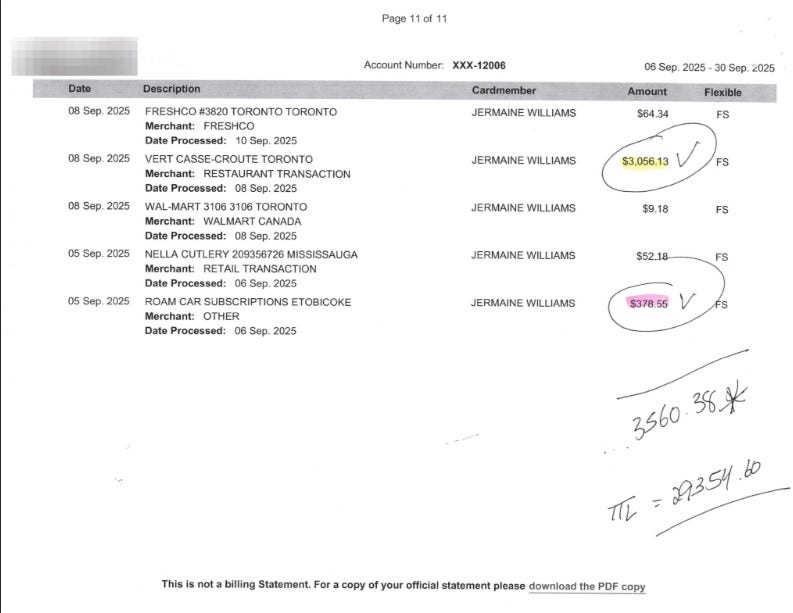
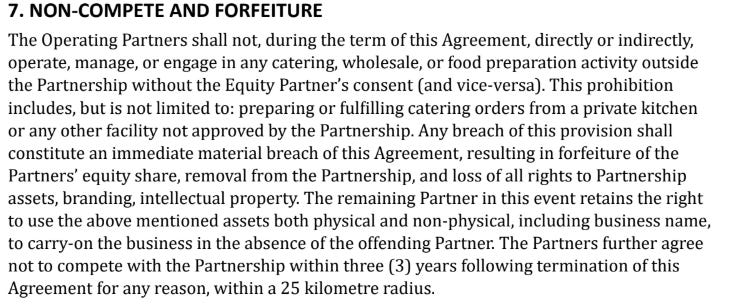
The conflict hinges on two competing interpretations of the August 1 partnership agreement. Williams points to Section 7, a clause that mandates the “immediate” forfeiture of equity if an operating partner engages in food-related activity outside the partnership without consent. From his perspective, the September credit card charges to Simms’ original catering company constituted a material breach that ended the partnership months ago. However, the founders point to Section 1 of that same document, which explicitly merged that catering company into the new partnership at its inception.
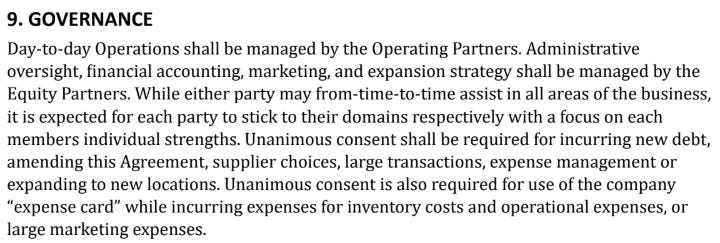
Furthermore, Section 9 of the agreement requires “unanimous consent” for use of the business expense card. Because the card was issued in Williams’ name, the documentary record suggests he was the primary supervisor of the very transactions he now characterizes as unauthorized. This leaves a central question: was the lockout a valid enforcement of a forfeiture clause, or was it an unlawful seizure of a business that had operated with the equity partner’s ongoing consent?
THE LOCKOUT, AND WHAT CAME NEXT
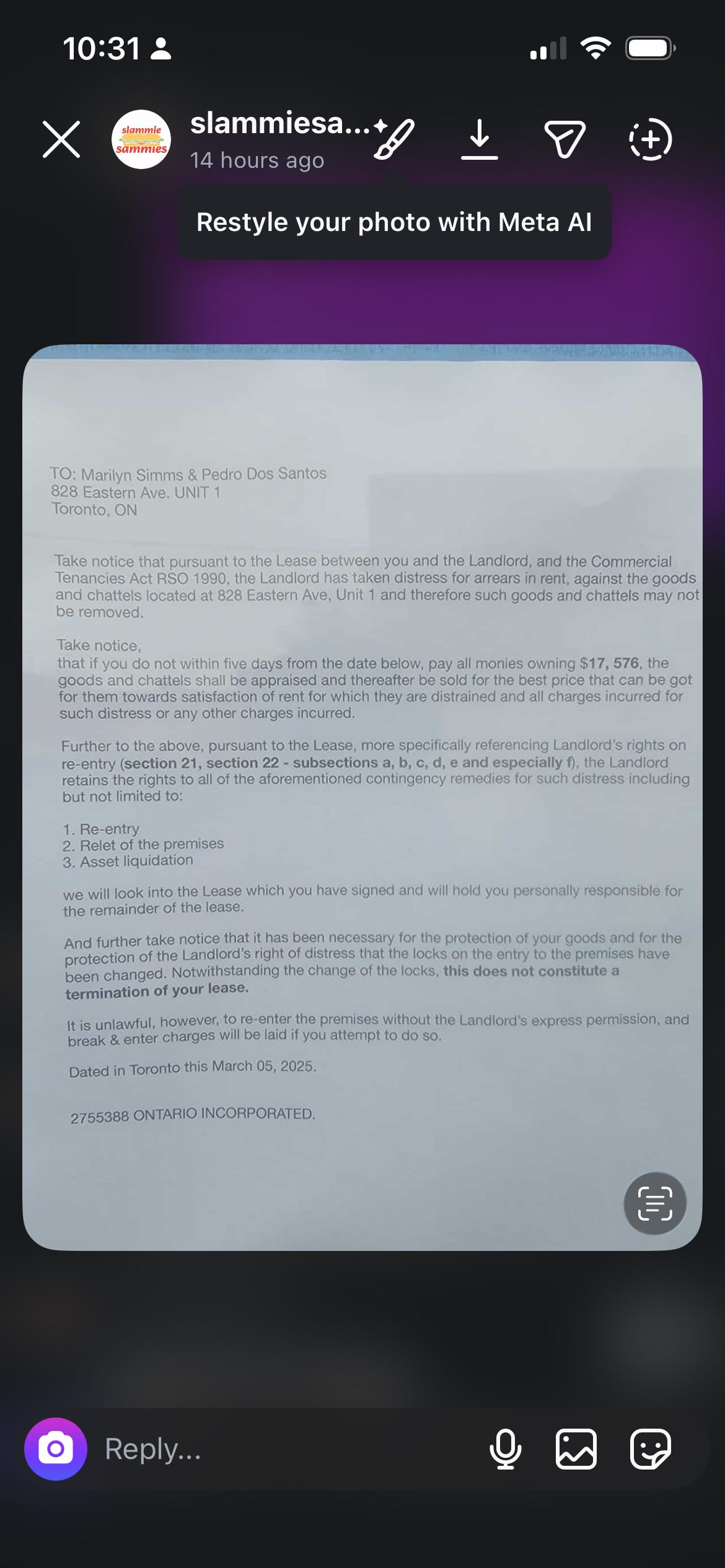
The lockout notice that Pedro found on March 6 was not sent by registered mail. It was taped to the door. The notice was also incorrectly dated March 5, 2025 — a full year before the lockout occurred, as noted by the founders’ legal counsel. The lease governing 828 Eastern Avenue, Section 11 specifically, requires written notice delivered by registered mail, with a 10 business day cure period before any enforcement action. That condition was not met.
Five days later, Williams sent a Capital Recovery Agreement to the founders via email. The document demanded $10,000 upfront, followed by $9,144 per month, structured to include $2,500 monthly toward a $75,000 capital recovery over 24 months, on top of rent. It also required the installation of surveillance cameras and mandated operating hours of 9am to 9pm, seven days a week. The founders say their joint bank account was closed following the lockout. Williams has stated it remained open until late March.
Pedro’s professional knives remain locked inside the building along with other belongings the founders have spent weeks trying to recover, including a skateboard belonging to a deceased friend. Williams, in his written response, dismissed these items as ‘broken, useless skateboards’ and described the attempts to retrieve them as emotional leverage.
The timeline leading up to the lockout raises its own questions. On February 18, two weeks before the notice appeared on the door, Grand Car Wash posted an ad on Kijiji listing the 828 Eastern Avenue space as a “Restaurant Partnership Opportunity,” with a note that the business was still operating. Around the time of the lockout, a second Kijiji ad appeared seeking a cook or chef for an “established restaurant,” using food photography that belonged to Pedro. In January, five weeks before the lockout, @tessiebellflorals posted an Instagram announcement describing a “pivot.”

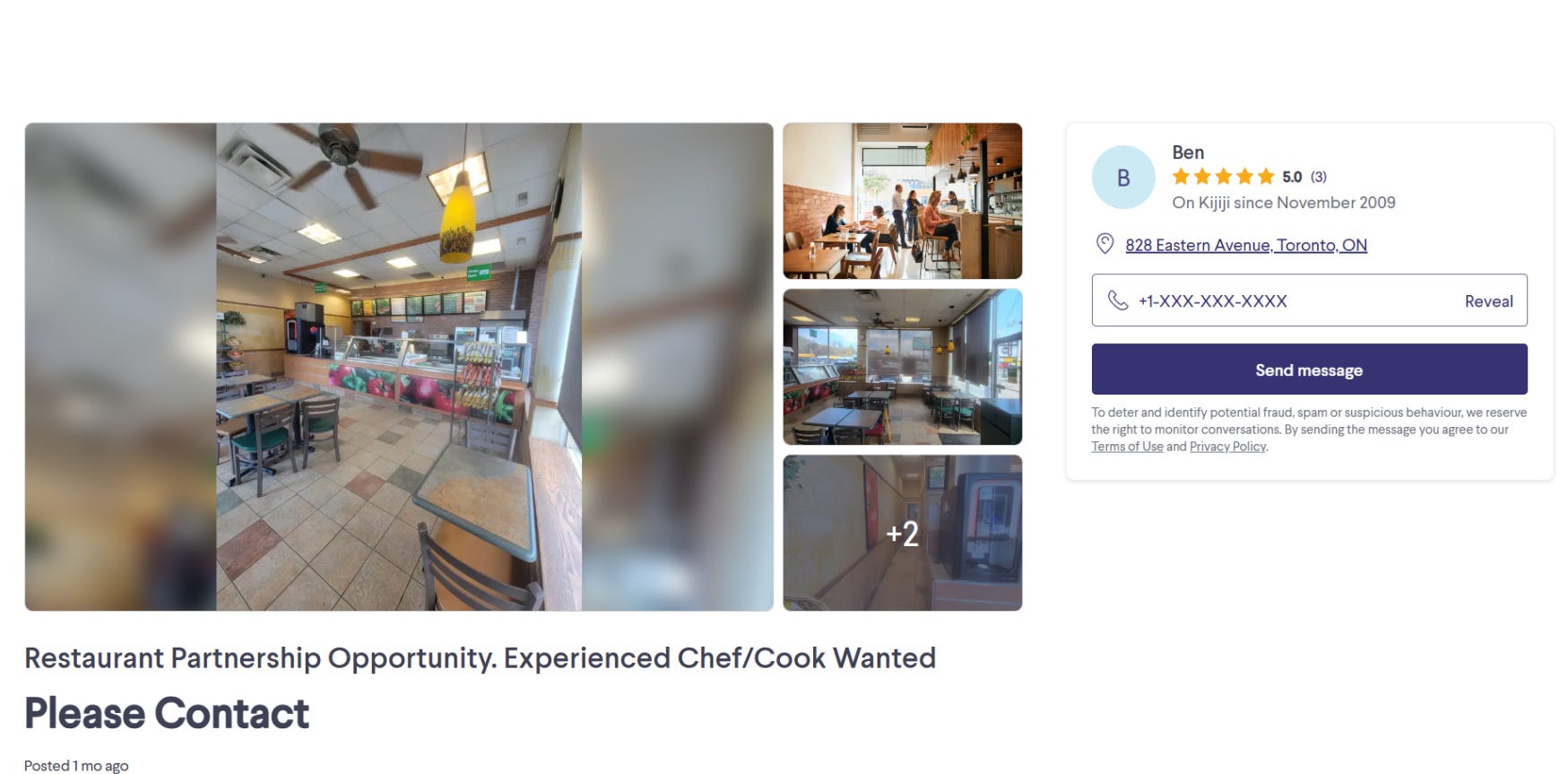
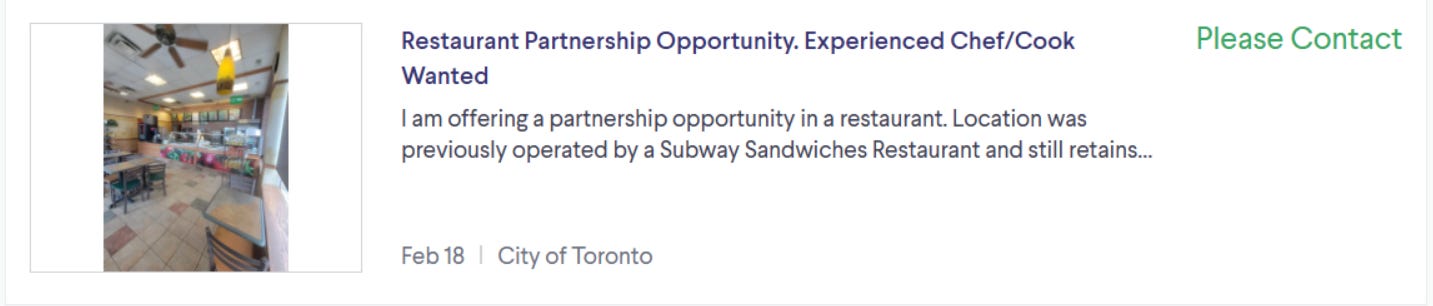
On March 16, Dickinson Wright issued a formal demand letter to Williams on behalf of the founders, asserting the lockout was unlawful and demanding restoration of access.
Twenty-four hours later, at approximately 10pm on March 17, a break-and-enter occurred at a business in the Eastern Avenue and Leslie Street area. According to Toronto Police Service news release Case #2026-565631, a suspect forced entry into the premises, damaged the cash register, took money from inside, and stole the debit machine before fleeing. Police described the suspect as a white male in a blue hooded jacket, dark pants, and black running shoes with white soles, and released an image. The investigation is ongoing.
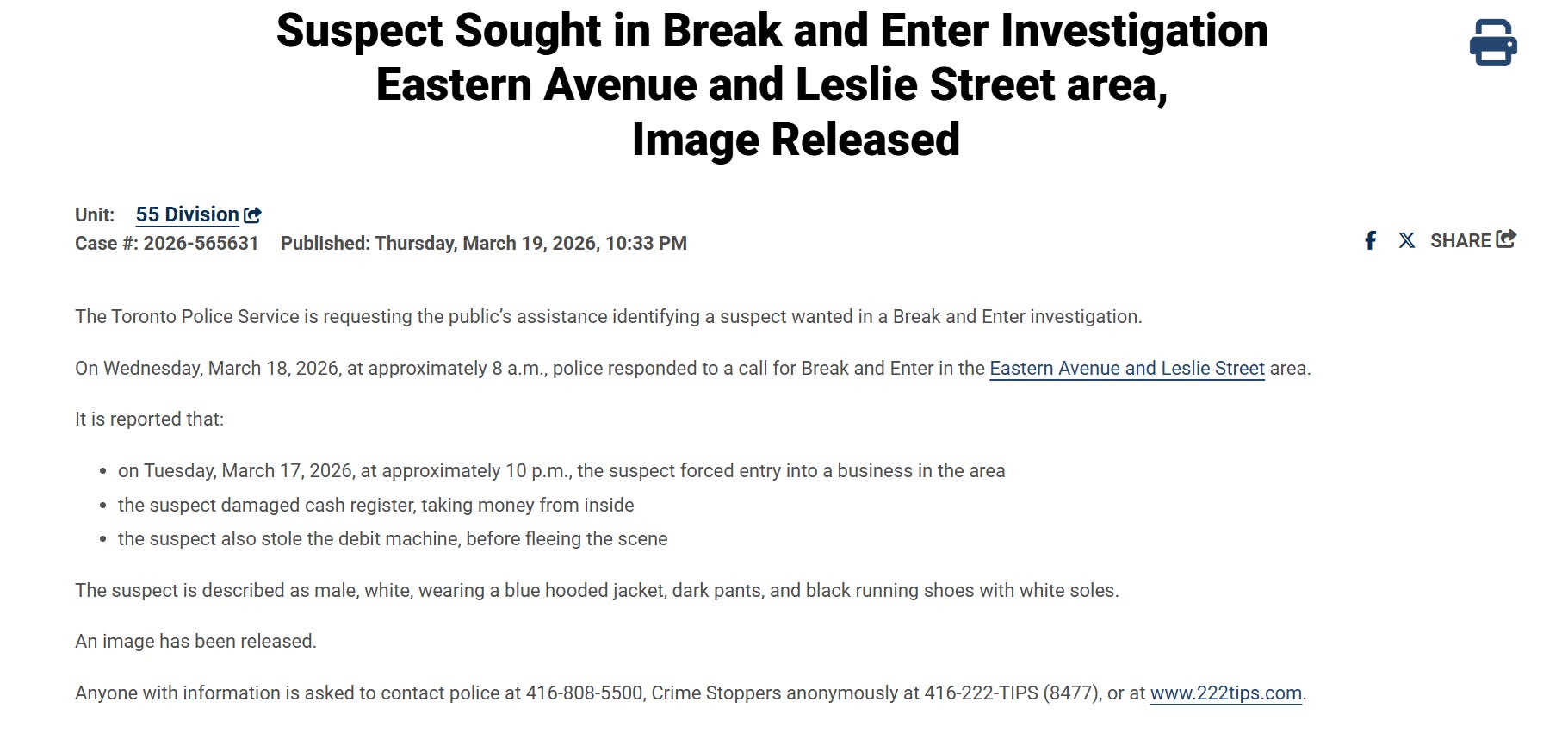
No connection between the parties to this dispute and the break-in has been established. Williams did not respond to follow-up questions about the break-in.
WHAT THIS MEANS, AND WHERE IT STANDS
What happened at 828 Eastern Avenue is, on one level, a dispute between a landlord and the tenants he was also invested in: a conflict over money, documentation, and competing accounts of who owed what to whom. Both sides have lawyers. Both sides have records. A resolution, if one comes, will likely arrive quietly and well after this article is published.
But the structure of the arrangement itself is worth sitting with. In Ontario, when your equity partner and your landlord are the same person, you have one set of leverage against two. The lease gives the landlord physical control of the space. The partnership agreement governs the money. When both relationships collapse at once, the operator has almost nothing they can enforce quickly. No injunction arrives before the locks are changed. No court date lands before the email with new terms. Independent operators who build something in someone else’s space carry this risk whether they know it or not. Pedro and Marilyn knew it by March 6.
What they built, in the meantime, was real in ways that don’t appear on any ledger. A neighbouring business owner across the street watched the sign come down approximately two weeks ago. The storefront went quiet with no crews, no announcement. “My hydro crew used to stop in every Friday on our way back to the yard,” wrote one city worker in response to news of the lockout this week. “Fridays became a tradition to stop by and see Pedro.” Another commenter put it plainly: “That’s what used to give Leslieville/Riverside its charm.”
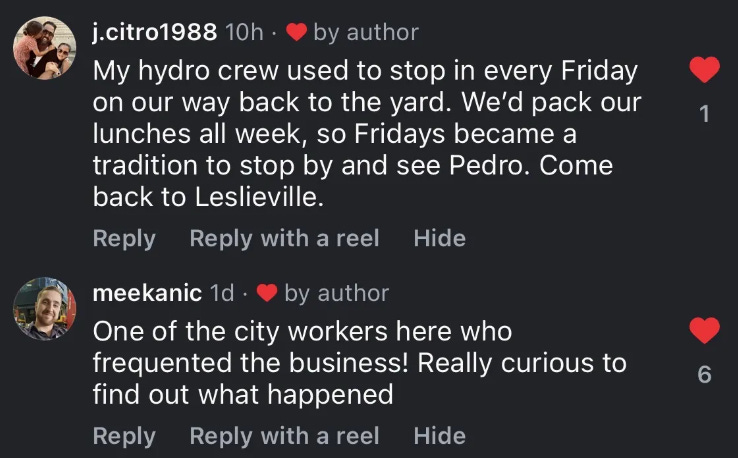
Williams can find another cook. He can reopen the space. He said he would. But the thing that made Slammie Sammies what it was — Pedro knowing every regular by name, the neighbourhood embedding itself into the weekly rhythm of the place — that isn’t in the recipes. It isn’t transferable. And it has zero legal protection.
The $20,000 commercial hood Pedro installed remains behind a locked door. Marilyn is still fielding catering calls.
The question 828 Eastern Ave is still waiting to answer: who opens that door next?
 Marie Pascual - Between Worlds
Leave a comment