What a trip through Vietnam taught me about craft, presence, and the people who make things that last.
By: Marie Pascual
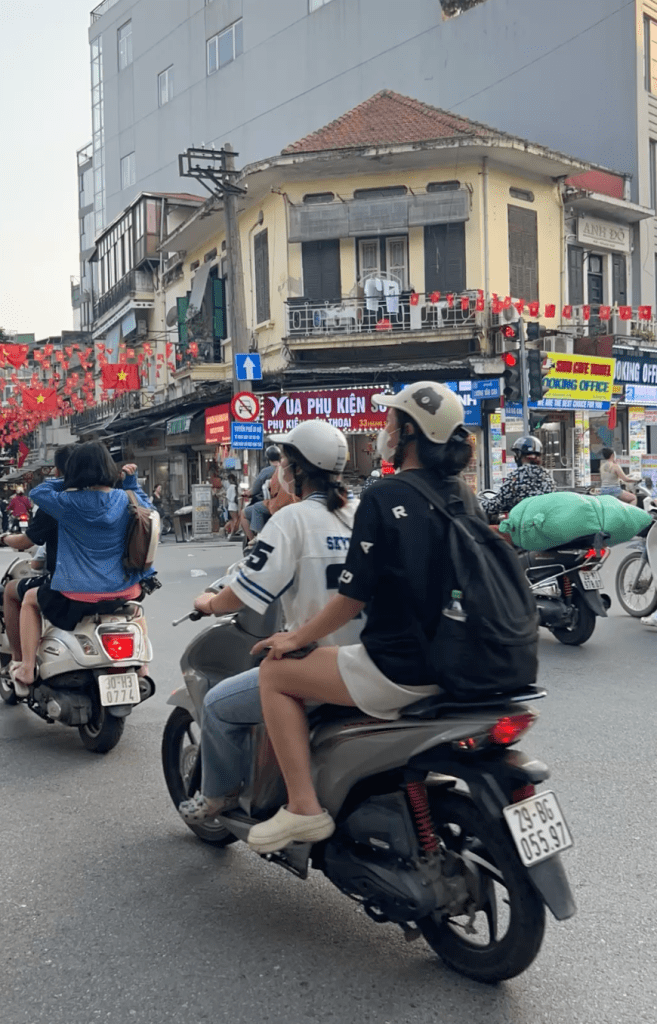
Sitting in the Grab felt like riding through waves as plankton on a large whale. People swam past on their scooters like a coordinated symphony, little moments of everyone’s lives slipping by.
School children clutching bubble teas and book bags. Parents with young kids: no helmets. Couples balancing carefully, hands on shoulders and thighs. Single riders heading to work. Delivery workers with bags of ice, others dragging juice stalls alongside, all weaving between buses, cars, and hawkers.
When the current slowed, it pooled into cafés ,quáns, where mornings began with coffee and evenings ended with beer. Chairs faced the street, hands wrapped around drinks, everyone watching life slide by like a film that never stopped rolling.
The horns here weren’t like the ones back home. They were communicative, thoughtful. A small reminder: hey, I’m here. Driving wasn’t about asserting yourself. It was about reading the room, trusting the rhythm, letting go. Honking wasn’t aggression; it was awareness. No one was sealed in their own climate, their own soundtrack. Everyone was on the same road, exposed to the same wind and rain; vulnerable, visible, relying on one another.
Back home, we drive in steel boxes, invisible to each other. Here, there were no walls, only people.
One morning in Hanoi, Nelson and I stopped for coffee at a lakeside café. The seating was tiered like a miniature theatre, the streets and commuters below our morning show.
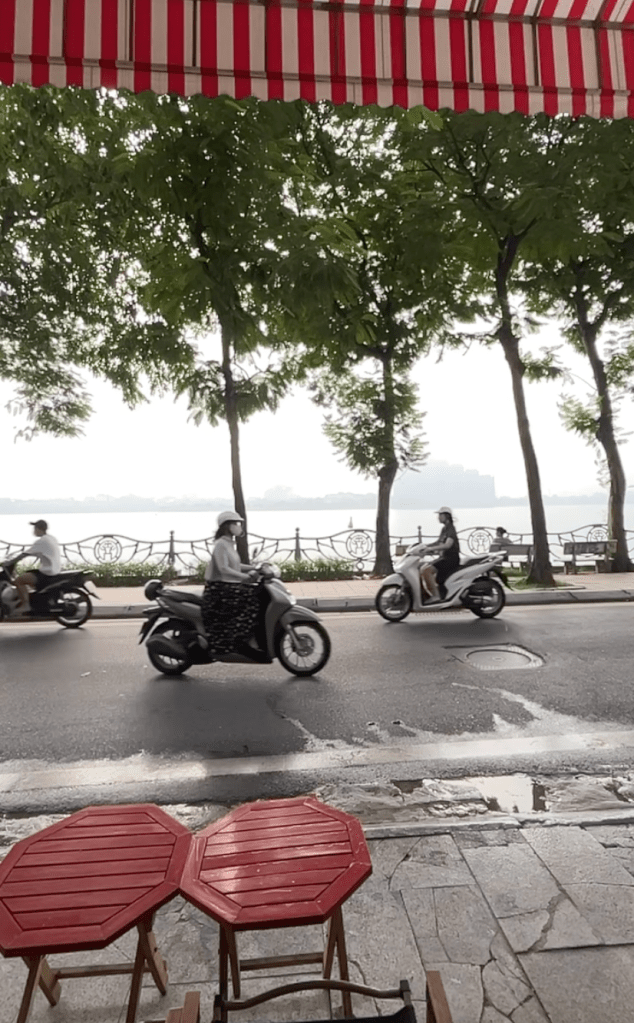
The clock ticked audibly against the soft music and hum of the espresso machine. There was a strange duality to it: the sound of time passing, the still lake behind us, the blur of motorbikes ahead. It gave me déjà vu, the same rhythm I’d known working at Vit Beo, an open kitchen where time stretched and folded.
I remembered that relationship with time: making every second count, yet slipping into something meditative between the prep work and watching customers at the window. The city outside never stopped moving, but for a few minutes, the café held still – a small rehearsal for learning how to look again.
A few days earlier, we’d left Danang for Hoi An – yellow walls, river air, a city that seemed to breathe slower on purpose.
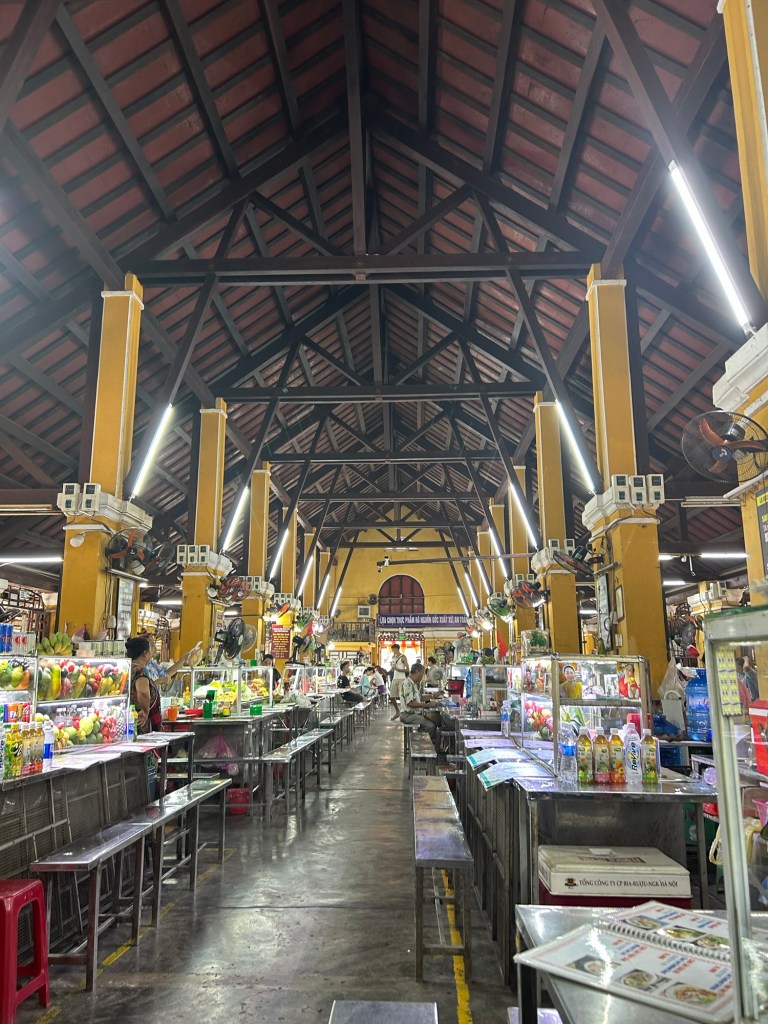
Inside the Central Market, light spilled through tall French-era columns like a cathedral for trade. The air smelled of herbs and river fish, the old timber beams humming with the memory of ships and spices. Every stall glowed under yellow bulbs, the present humming with the past.
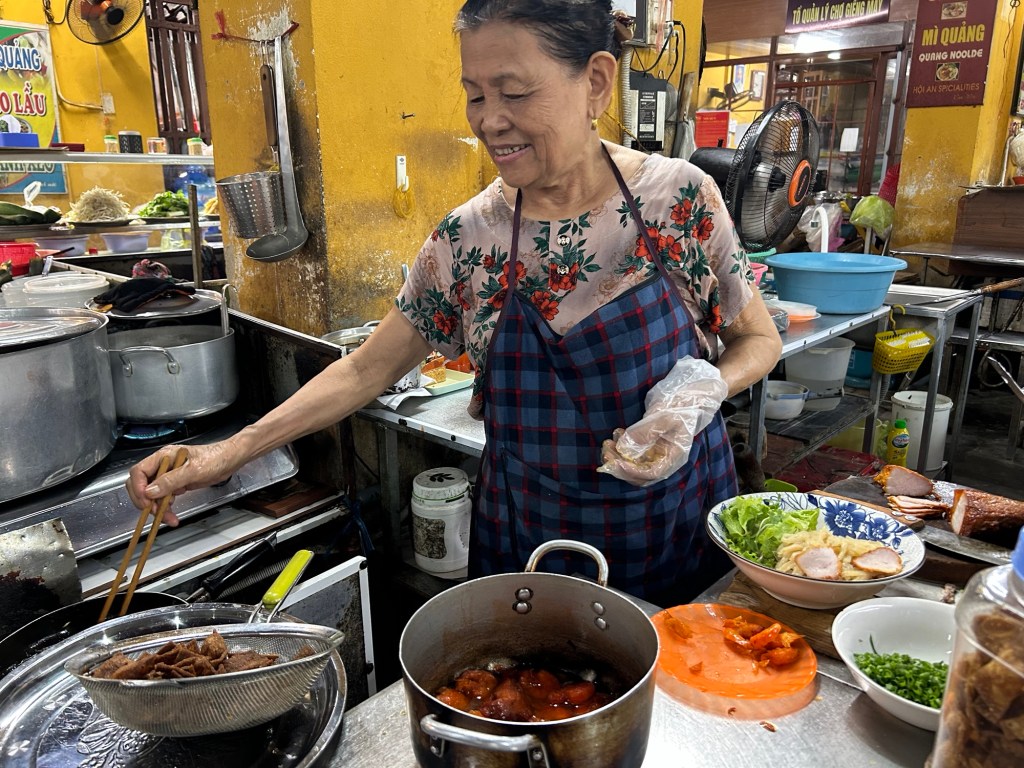
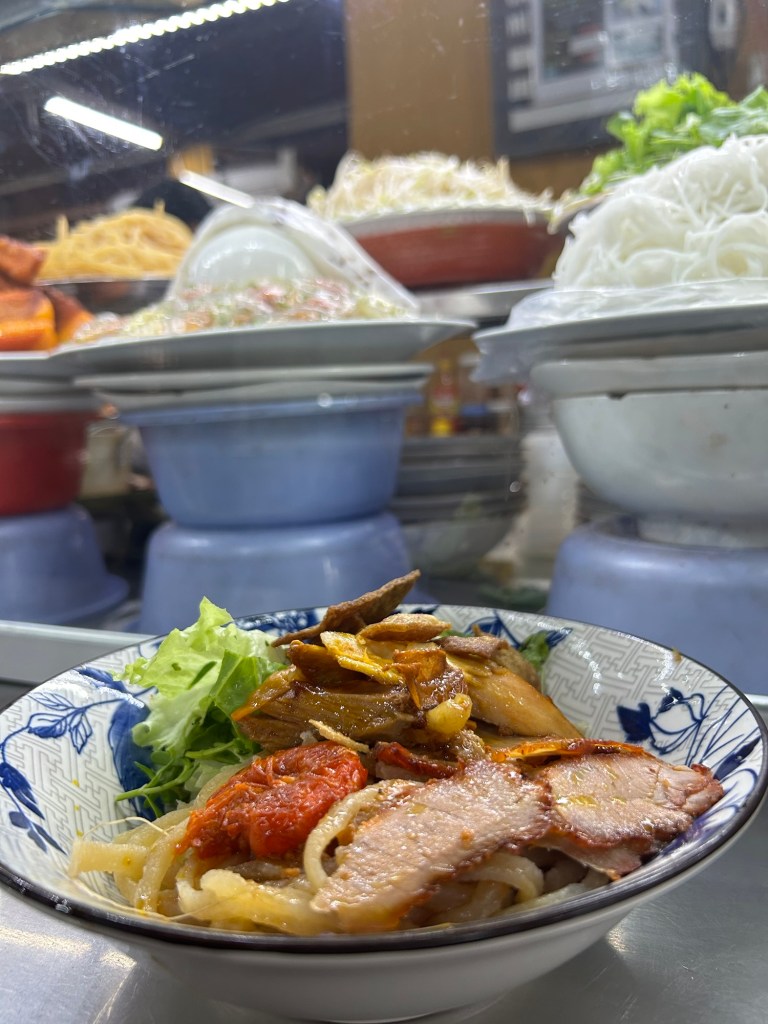
I ordered cao lầu, noodles that only exist here — smoky, amber, somewhere between ramen and udon. Sitting under the fluorescent lights, eating from the woman whose stall Bourdain once blessed, it felt less like lunch and more like communion. His voice lingered somewhere in the steam, reminding me why I ever fell in love with food.
I didn’t yet know that the lye water came from the Bá Lễ well, that the ash was from the Cham Islands – that this dish couldn’t exist anywhere else. But even before I learned that, I knew: some things belong exactly where they’re born.
Hoi An felt like a city built by hands that never stopped remembering. Every corner held a craft; shoes, silk, lanterns, noodles, each shop smelling faintly of cedar, oil, and time.
Thuyet’s leather shop felt freeze-framed in an older century. She smiled as we walked in, asking about Canada’s winters and what kind of soles we’d need for the cold.
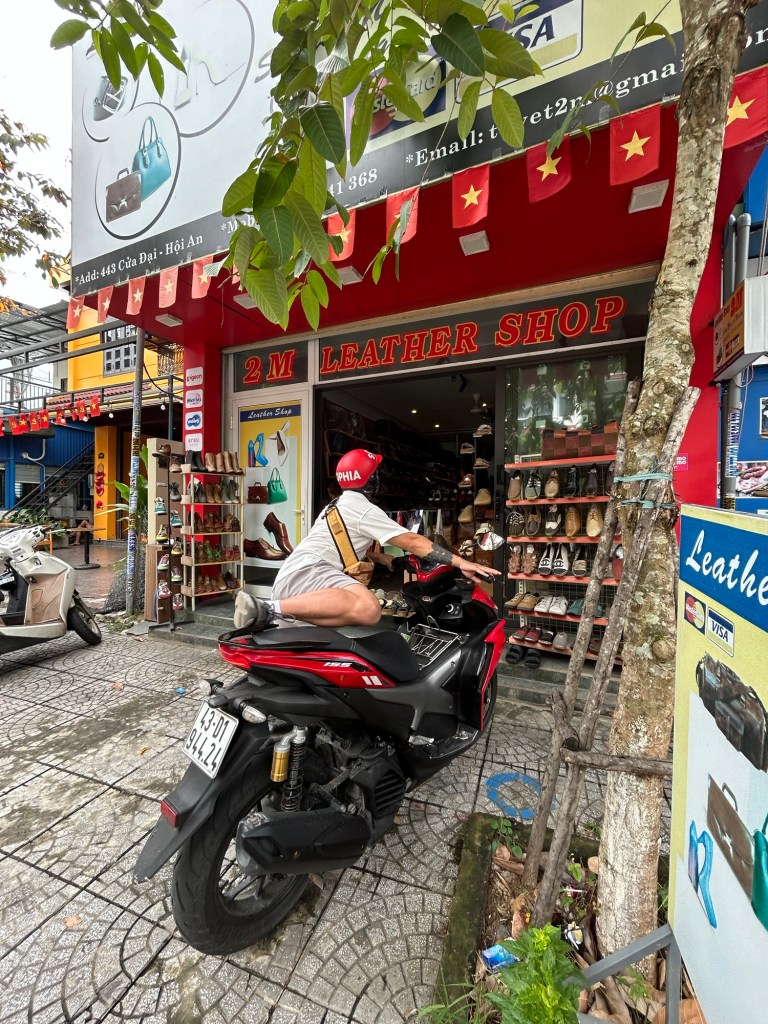
“Grip,” she said, tracing a line on paper. “And lining. Good for walking.”
We were tired of cheap plastic shoes that cracked after a season. My father’s voice echoed in the back of my mind: buy things that last; respect the work that lasts.
By the time we left, she’d measured us for oxfords and loafers that felt like small promises; $200 for something built to outlive the year.
When we returned to the market, the cao lầu lady recognized us instantly. No words, just the warmth of being remembered. More herbs, more noodles, the broth smokier than before. She sat with us while we ate, thirty years of muscle memory in the way she stirred the pot.
I asked if I could film her. She laughed and waved me closer.
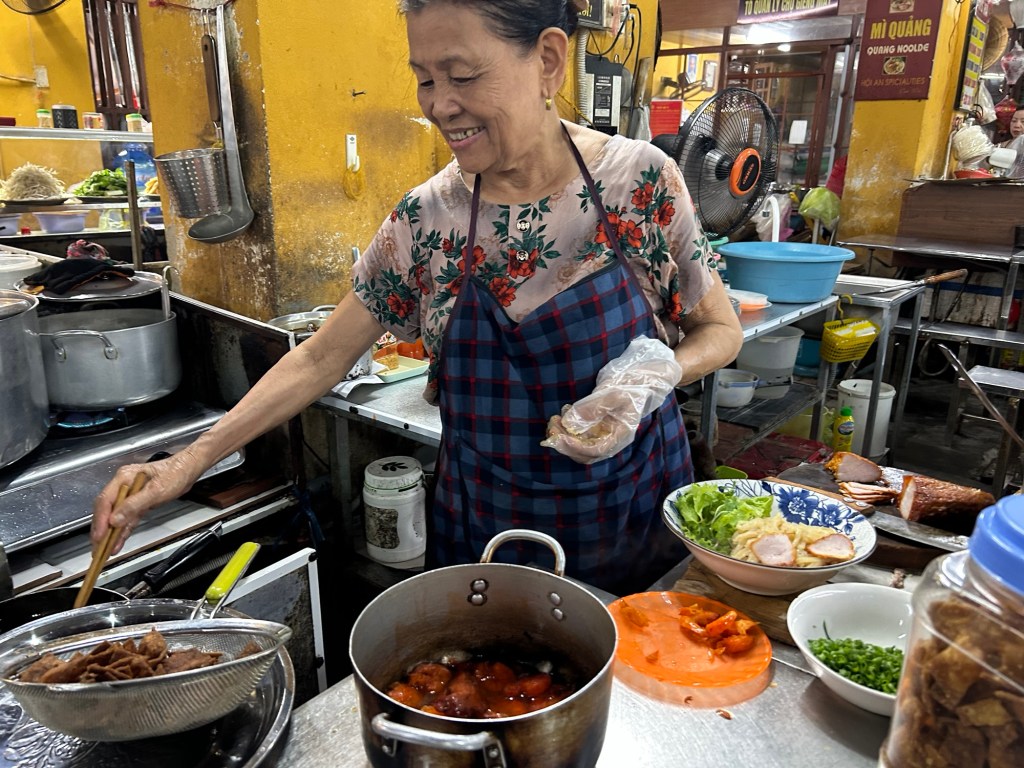
Some people serve meals; others pass on memory.
Later, by the Bá Lễ well, we met a jeweler whose shop was strung with silver and light. When Nelson picked up a ring and said we were just holding it, she smiled.
“Some customers forget to pay,” she said. “They tell me later, and I let them. It’s all about trust, isn’t it?”
She cleaned my engagement ring without being asked, teased us about marriage, and pressed a card into my hand – her best friend’s, a tailor. We hesitated, but moments later the friend arrived on her motorbike, insisting we come.
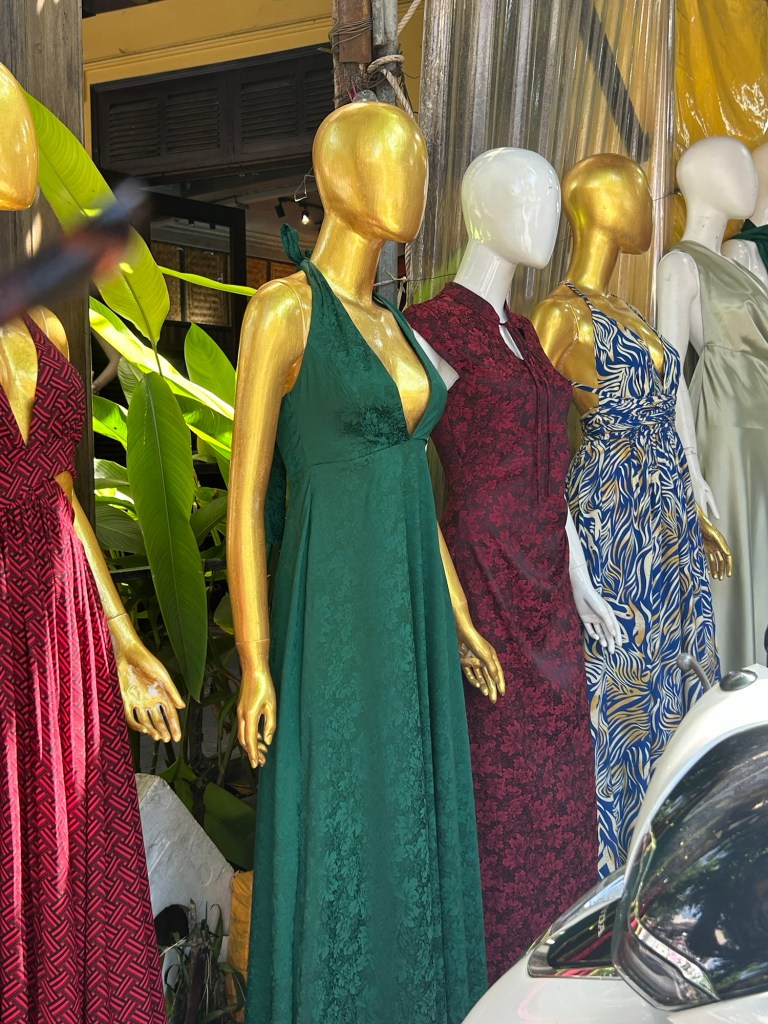
The tailor’s shop was tucked behind a row of lantern stalls. Inside, her family offered us water, cigarettes, and time. They saw our hesitation about the price and lowered it.
“A slow day,” they said.
She walked me through fabrics; linen, cotton blends, weights that would breathe in the heat. Her hands moved quickly, but her attention was careful. She asked where I’d wear it, whether I felt comfortable in dresses.
I told her I didn’t, not really. I’d spent most of my life in kitchens, in jeans and chef coats, and feminine clothes always felt like costumes I was trying on for someone else.
She nodded like she understood.
I wanted green, something safe, something I could imagine myself in. But she shook her head, holding up mustard gold against my arm.
“Better for your skin,” she said. Not as a sales pitch. As a fact.
I looked at Nelson. He shrugged. I looked at the fabric.
I trusted her.
Six hours later, we came back. She handed me the dress, and I stepped into the small curtained corner to try it on. The fabric settled against me like it had been waiting. Not tight, not loose — just right, in a way I didn’t know clothes could be.
I came out, and she smiled. Adjusted the shoulder slightly. Tugged the hem.
“See?” she said.
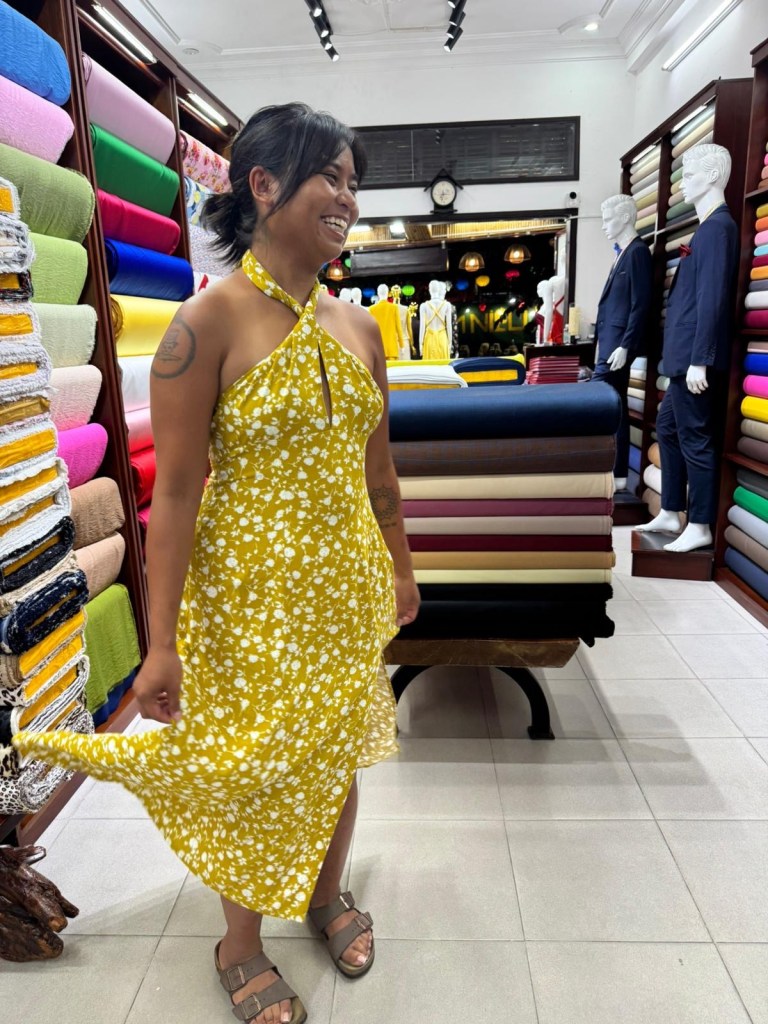
The person looking back wasn’t a stranger, but she wasn’t entirely familiar either. The dress fit my body, but more than that, it fit something I hadn’t known how to ask for. I looked like someone who belonged in her own skin.
When I told her I usually felt insecure in dresses, she waved me off.
“You just needed the right one,” she said.
By the time we left Hoi An, we carried more than what we bought. Shoes, noodles, jewelry, fabric; all made by hands that believed in lasting things.
When we left, our suitcases were heavier, but it wasn’t the weight of things. It was the afterglow of being seen. Each craftsperson had left a trace: a stitch, a shine, a taste that lingered longer than it should have.
In Hanoi, that visibility turned inward. I’d spent days watching others shape, stitch, and season. Now, it was my turn to hold the hammer, to feel what it means to make something that might last.
The morning began with rain, ankle-deep and relentless. Nelson and I waited under an awning until our guide, Mai, appeared through the downpour, umbrella in hand, smiling like it was nothing. She led us down a narrow street in Da Sy village, past rows of blacksmiths whose workshops opened directly onto the road, sparks leaping into the wet air like fireflies refusing to die.
Inside, the shop was small and alive with heat. Mai introduced us to the two smiths we’d be working with; a mother and son. The older woman ran the kiln; the man, maybe a decade older than us, worked the grinder. Mai told us they’d been doing this for nearly forty years; homemade kiln, muscle memory, nothing digital or automated.
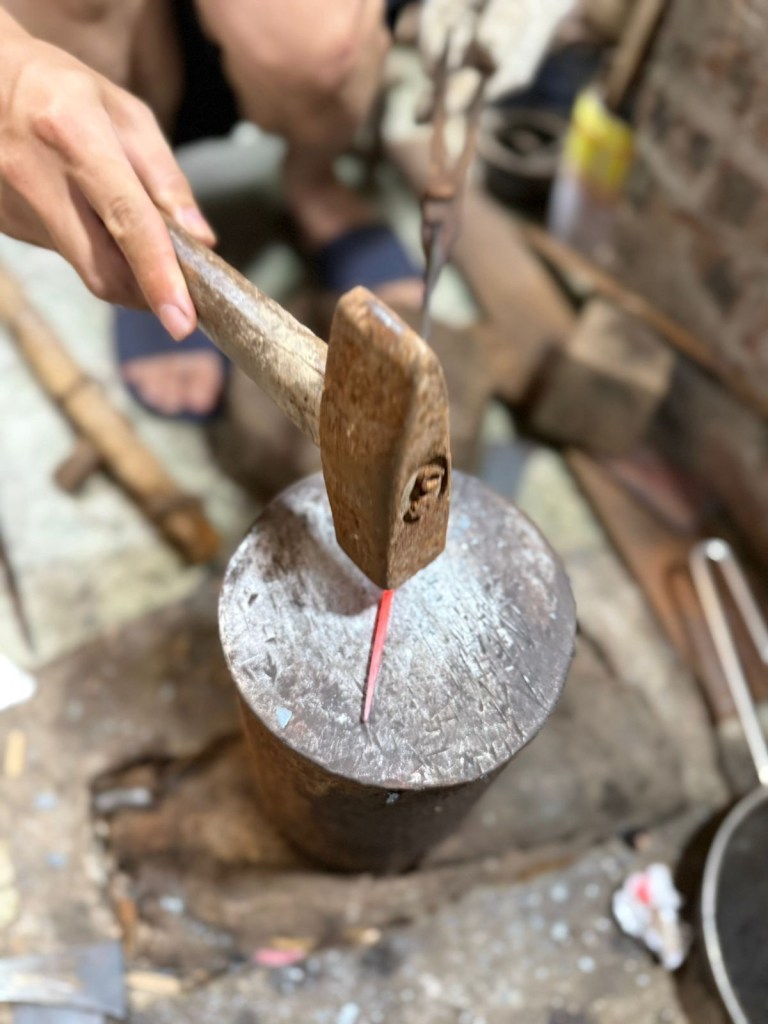
We began by tracing our knife designs onto sheets of carbon steel. The woman positioned a nail against the outline, and I hammered – her hand steady, mine uncertain. The rhythm found me slowly: strike, breathe, strike. The unspoken understanding between us.
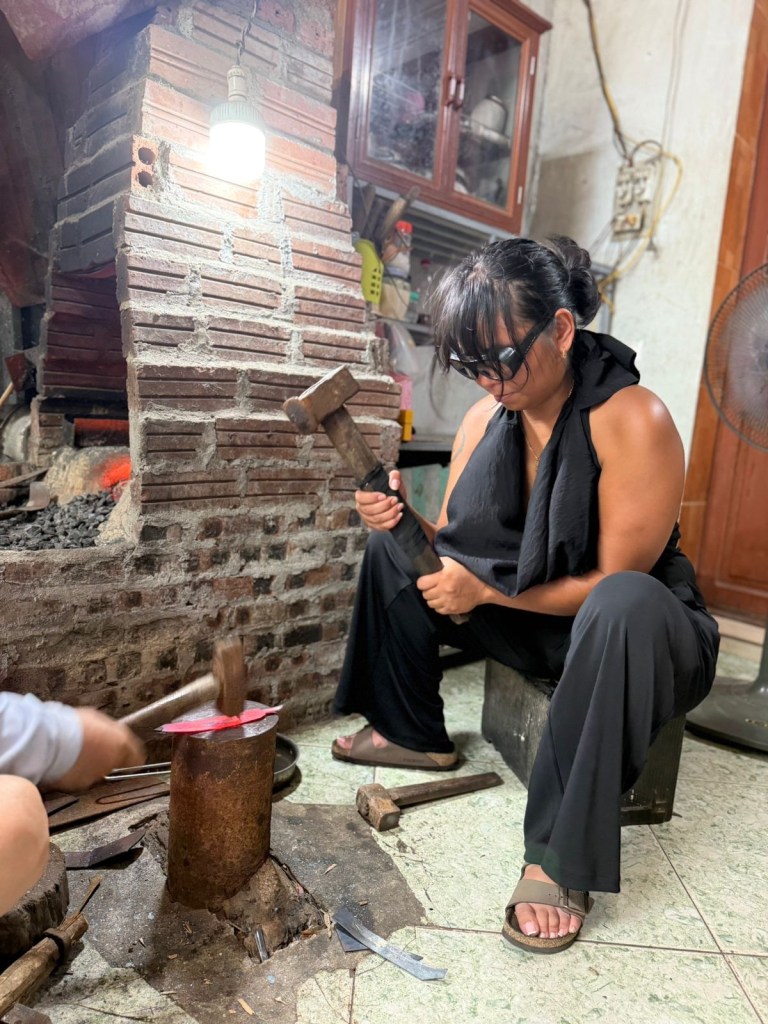
Eight years of using knives, and I’d never felt one belong to me like this. The handle was imperfect, my work on the grinder uneven, but every flaw was mine. It carried something of me in the metal.
I thought of the tailor’s hands, the jeweler’s laugh, the cao lầu lady’s ladle, each moving with the same patient rhythm.
Mai’s daughter sat nearby, mimicking us with a toy hammer. The sound of her play tapped lightly over the roar of the forge, a small echo of what might continue.
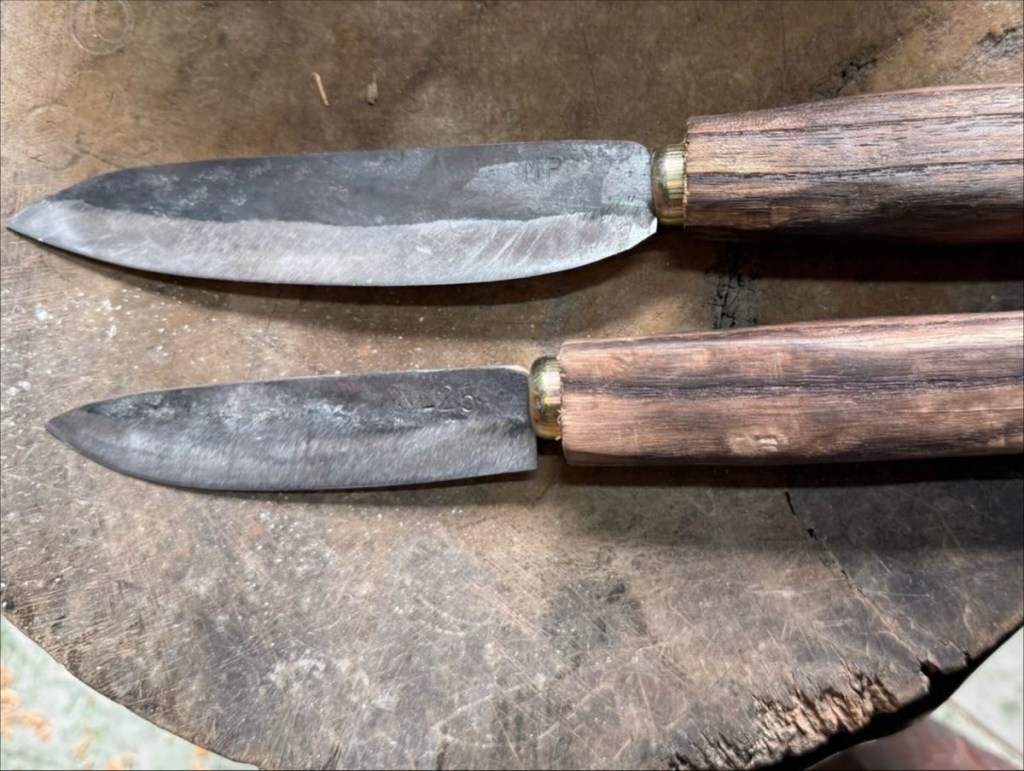
When we finished, Mai let us etch our initials onto the blades. I pressed mine in slowly, metal against metal, and felt that same quiet reverence I’d felt in the market in Hoi An; a presence that asked for care, not perfection.
Later, back in the quiet of our Airbnb, I kept turning the knife in my hand, its weight neither tool nor souvenir, but something else: proof that I’d crossed from witness to maker.
A few days later, on the way to the Củ Chi tunnels, I saw that same devotion take a different form.
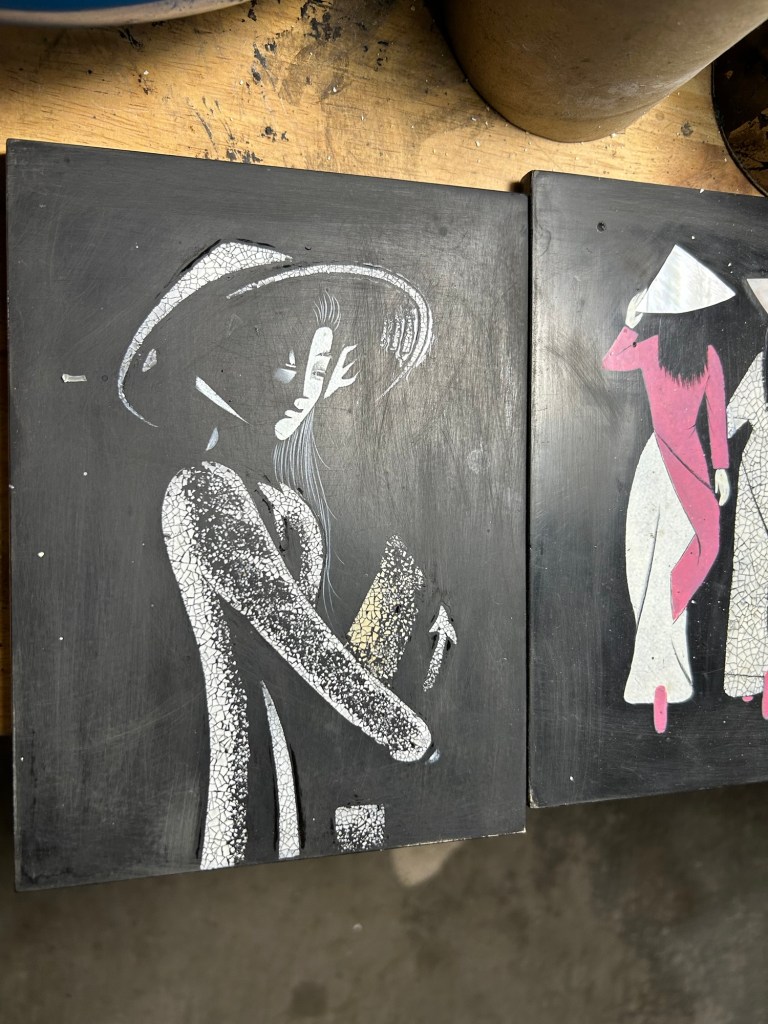
In a small factory, women who had survived Agent Orange were inlaying eggshell and mother-of-pearl into lacquer boards — cranes, conical-hatted figures, whole worlds made from fragments. The air shimmered with heat and resin. A sign mapped the process: inlay, varnish, polish, over and over.
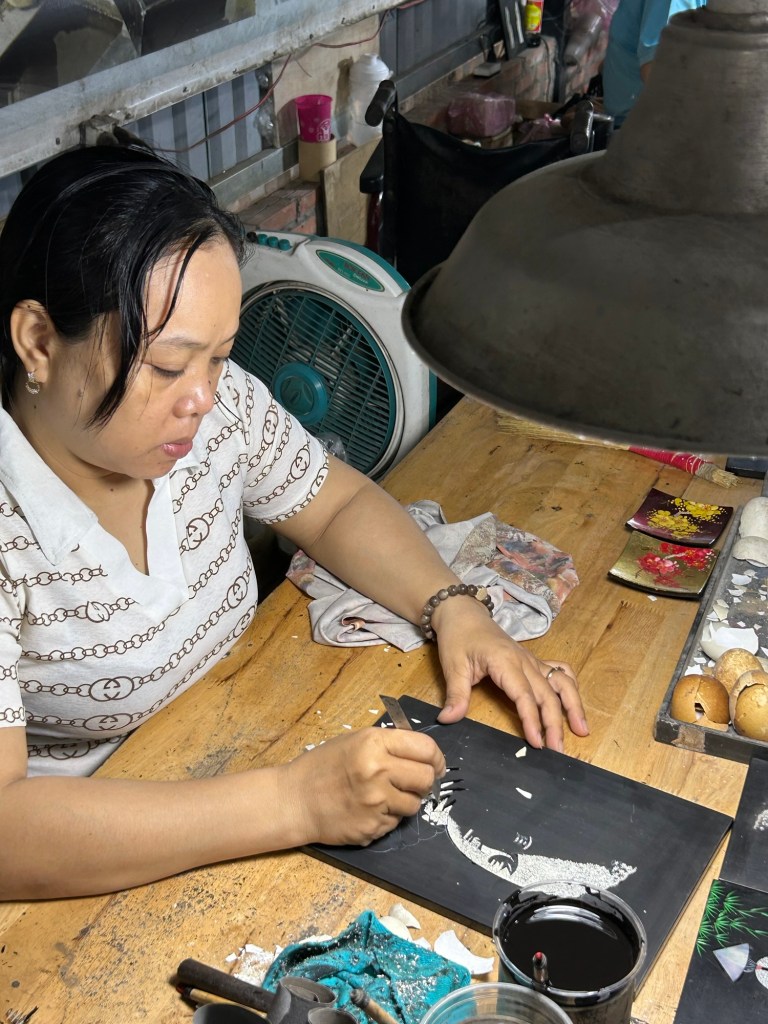
Watching them, I realized the forge wasn’t unique. Every craft was its own quiet resistance — a way of keeping memory alive through repetition. To keep making after loss, to let your hands remember, is its own kind of victory.
Back home, I keep thinking about visibility. How in Hoi An, craft lived in the open: tailors waving you in from doorways, cooks stirring over the same pots for decades, the sound of hammers echoing through Da Sy. And how, in Toronto, that same work hides behind glass and drywall. The work is there, you just have to look harder.
At Vit Beo, though, the kitchen was open. Customers sat across from the line, close enough to watch Kaz teach me how to flick fried rice or to ask which pan I used for which dish. Sometimes they’d comment on the smell, the sizzle, the choreography. Those moments stayed.
It’s the same feeling watching Vina paint nails, her hands moving with the same precision I once used for plating. Or her husband, a tiler, pointing out which floors in a mall were laid right. They’re all working in the same language: one of care, repetition, attention. It just takes being close enough to notice.
Maybe that’s what this trip was about; proximity. To be near enough to see how things are made, to know the hands behind them, to remember that everything we touch comes from someone else’s work.
I don’t know how to hold onto that feeling when I go home.
But I know I’ll be looking for it.


 Marie Pascual - Between Worlds
Leave a reply to Amanda Cancel reply